Confessions of a Recovering Perfectionist – Part 3

As a child, I remember listening to adults pray, and learning certain phrases from them such as “bless us that no harm or accidents may befall us” and “bless this food that it will give us nourishment and strength.”  One of these was asking God to forgive us of our sins.  But often it was coupled with other words, so I would hear “forgive us of our sins and shortcomings” or “forgive us of our sins and imperfections” and even “forgive us of our sins and weaknesses.”  

So the idea was that I needed to repent of not only my sins, but also my weaknesses.  This led to seeing weakness as a sin, which is a destructive mindset.  It became more confusing when I read in Ether 12:27 that the Lord gives us weakness.  

So I was very grateful to see in last month’s Ensign this excellent article:  It Isn’t a Sin to Be Weak by Wendy Ulrich.  She helps us to see that limitations and inadequacies are not sins and do not keep us from being clean and worthy of the Spirit.  If you haven’t read the article, I invite you to take a few minutes and read it.  

As I’ve understood more about this concept, Ether 12 makes more sense.  The Lord gives us weakness not that we we need to repent of it, but so that it makes us humble and brings us to Him and  His enabling power.  Then He doesn’t remove our weak things; He makes them strong.

Claiming Shame
There’s a difference between guilt and shame.   Guilt is about my actions and behavior.  Shame is about me, as a person.  Guilt says, “I made a mistake” or, “I did something bad.”  Shame says, “I am a mistake” or, “I am bad.”  Guilt can be beneficial when it causes us to repent of wrong-doing.  But shame is never beneficial.

When I first heard about the effects of shame years ago, I didn’t think it applied to me.  After all, I was optimistic and upbeat in my disposition.  I spoke self-affirmations to myself to keep me positive.  I was always saying things like, “It’ll all work out,” or, “Everything’ll be OK, just wait and see.”

But as I read the writings of Brené Brown, I started to see that shame was the basis of my perfectionism.  The less we talk about shame, the more we have it.  The more we talk about shame, the less control it has over our lives.  So as I’ve begun to talk about it, I really have noticed that it is decreasing.  I feel more authentic.  I’m able to have greater empathy for others.  I feel that I’m worthy of love and belonging.  

Shame is universal and one of the most primitive human emotions that we can experience.  (Think of Adam and Eve when they became aware that they were naked.)  The only people who don’t experience shame lack the capacity for empathy and human connection.

Sometimes we may want to think that shame is only felt by those who have suffered horrible traumas.  That isn’t true.  We all experience it.  And while we tend to think that shame is relegated to the dark closets of our lives, it actually makes itself known in more common areas:  appearance and body image, parenting, work, money, health, aging, addiction, religion, etc.

Shame thrives in an environment of silence, secrecy, and judgment.  Under these conditions, shame becomes toxic.

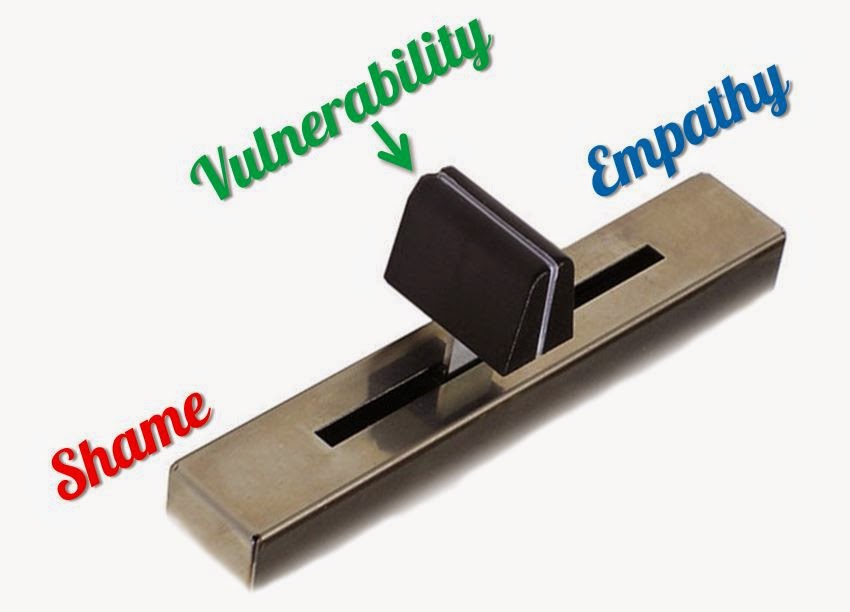
The opposite of shame is empathy.  On a continuum, with shame on one end and empathy on the other, the control knob that moves us from one side to the other is vulnerability.  The less vulnerable I am, the more I am on the shame side.  The more vulnerable I am, the closer I get to the empathy side.  

Numbing My Emotions
It’s hard to go through life feeling that I’m “bad” and that I’m a disappointment to God and others.  So I learned how to numb those emotions.  The problem with this is that we can’t selectively numb emotions.  I can’t say, “I think I’ll numb shame, anger, insecurity and regret, but I’d like to still feel happiness, excitement, gratitude and peace.”  When I choose to suppress any emotions, I suppress them all.  Consequently, I also suppressed my ability to feel the Spirit.  And that’s a lonely and dangerous place to be.  

Taken to an extreme, this is where addictions show up.  We anesthetize to make us feel good.  The world uses alcohol, drugs, sex, pornography, gambling, etc.  I could never go there, because those were obviously against the rules.  But there are other addictions that are easier to justify:  staying busy, keeping control, compulsive shopping, food, extreme exercise, caretaking, being organized, and social networking.  These are harder to see as potentially destructive.  

So as I’ve begun to allow myself to feel again, I’m better able to recognize and label my emotions.  The “negative” ones are less threatening to me.  And I’m learning better ways to express them.  

Black-and-White Thinking
Part of my OCD is the tendency toward all-or-nothing thinking.  I have to be perfect or I’m a failure.  It’s like there’s no middle ground or gray area.  I use words like “always” and “never,”  “ultra” and “uber.”  Life is either wonderful or horrible.  If I’m not excellent at something, then I’m simply mediocre, which is as bad as being awful.  

This thinking is also tied into comparison and competition.  I’m always aware of how others are doing and how my performance compares with theirs.  If I’m only getting the 2nd highest grade in a class, it’s devastating.

Since I’ve recognized this tendency in myself, I’m better able to be content with lowered expectations.  When I hear my mind thinking in black and white, I know how to talk back in appropriate ways.  One scripture that helps me here is that “it is not requisite that a man should run faster than he has strength.”  (Mosiah 4:27)

To be continued . . . with Part 4.

Confessions of a Recovering Perfectionist – Part 2

For a large part of my life, especially the past seven years, I’ve felt “stuck”—like something was impeding my progress.  I felt like there was something significant that I wasn’t experiencing, but was supposed to be.  I couldn’t put my finger on it.  I’d hear people talk about certain concepts that should have been so simple to understand, but they were just not penetrating my head nor my heart.  

When I look back now, I can see that I truly was progressing, just so incrementally that I didn’t recognize what was happening.  The Lord was laying a foundation for what He was going to do with me.  There are numerous remarkable experiences I’ve had, which at the time didn’t seem that big, but it really was a “line upon line” process where one bit of understanding led to the next, and so on.  

Things really started to change in 2011, when a conference talk by Pres. Eyring made a particular impression on me.  I acted on those impressions, and they led to a series of good decisions that guided me in the direction I needed to go.  The most important changes I needed to make were regarding the condition of my heart.  

In the fall of 2014, I was attending a workshop with my wife.  The speaker shared some ideas that resonated with me.  I spoke with him afterward and felt that he could help me break through whatever barriers were keeping me stuck.  It turns out that he was a therapist, and he agreed to meet with me.  

It didn’t take long for him to recognize in me the symptoms of shame.  

Once I knew what I was fighting, that recognition helped me identify how shame really is the birthplace of perfectionism.  

I also recognized that my feelings of shame were directly related with my inability to feel God’s love for me and to believe that I am worthy of love and grace.

Following are some of the concepts and “aha” moments that have helped me in this journey.


God Loves Me

In the past couple of months, I’ve had several experiences when I’ve truly felt God’s love for me.  It’s not just an intellectual assumption or something I learned in Sunday School and then repeated.  Other people may have these frequently, and so they are perhaps not that unique to them, but for me, they are a different and very important part of my recovery.  Here are a few that were life-changing and really have stuck with me.  

I was reading the January 2015 Ensign magazine.  Elder LeGrand R. Curtis’ article entitled “He Ran, and Fell on His Neck, and Kissed Him” recounts the parable of the prodigal son.  I’ve read and heard this parable many times, and I always thought I understood the point of it.  But this time (I’m sure it was because of the new heart God is giving me), I finally saw the father in the story as my Father, and the son as me.  The son “came to himself” and determines to go back home.  The father isn’t standing there on the porch with his hands on his hips with a “well, it’s about time you came to your senses” look.  Rather, while the son is “yet a great way off,” the father sees him, has compassion on him, runs to him, falls on his neck, and kisses him.  As I read this I was overwhelmed with the Father’s love for me!  It was very real and it filled my heart, something I’m not used to, but am becoming increasingly grateful for.

I found an incredible song.  The first time I heard it, I wept as I realized that this song, like no other I’ve found, expresses what has happened in me over the past few months, since:

  • I followed a prompting and started seeing my therapist
  • I was directed to the work of Brené Brown
  • I’ve found opportunities for expression and belonging
  • I’ve stopped numbing my emotions
  • I’ve started to reclaim my life from shame and OCD
  • I’ve felt more my Father’s love for me than ever before!

Sorry to sound so dramatic, but this is truly powerful for me!  It’s what my heart has been craving all my life!  God is giving me so much hope for the future!  The song is The Glorious Unfolding by Steven Curtis Chapman.

I was studying a talk by Wendy Ulrich entitled Trusting in the Lord.  (She is the author of Weakness Is Not Sin, which has been a landmark read for me.)  As part of the talk, she invites her audience to participate in some guided imagery.  I participated and received a profound witness that God does, indeed, love me!  

I’m a member of my stake High Council, and we meet every other Sunday at 6:00am in the morning.  As part of those meetings, we often hear reports from missionaries who have just returned from their missions.   On one morning, all three returning missionaries shared, in their own individual ways, their testimonies of how we are “on God’s radar” and that he cares so much for even the weakest of His children.  The Spirit was strong and confirmed the truth of their words.  Tears rolled down my face, which is not something I let happen very often in public—I would typically hide it or suppress the feelings that were causing me to cry.  But this time I didn’t.  Why try and stop the very emotions I have prayed so much to be able to feel?  


Some Myths About Perfectionism

The following points are taken right from Brené Brown’s The Gifts of Imperfection, which is a must-read for anyone really struggling with this issue.

  • Perfectionism is not the same thing as striving to be your best. Perfectionism is not about healthy achievement and growth. Perfectionism is the belief that if we live perfect, look perfect, and act perfect, we can minimize or avoid the pain of blame, judgment, and shame. It’s a shield. Perfectionism is a twenty-ton shield that we lug around thinking it will protect us when, in fact, it’s the thing that’s really preventing us from taking flight.
  • Perfectionism is not self-improvement. Perfectionism is, at its core, about trying to earn approval and acceptance. Most perfectionists were raised being praised for achievement and performance (grades, manners, rule-following, people-pleasing, appearance, sports). Somewhere along the way, we adopt this dangerous and debilitating belief system: I am what I accomplish and how well I accomplish it. Please. Perform. Perfect. Healthy striving is self­-focusedHow can I improve?  Perfectionism is other-focusedWhat will they think?

Understanding the difference between healthy striving and perfectionism is critical to laying down the shield and picking up your life. Research shows that perfectionism hampers success.  In fact, it’s often the path to depression, anxiety, addiction, and life-paralysis.  Life-­paralysis refers to all of the opportunities we miss because we’re too afraid to put anything out in the world that could be imperfect. It’s also all of the dreams that we don’t follow because of our deep fear of failing, making mistakes, and disappointing others. It’s terrifying to risk when you’re a perfectionist; your self-worth is on the line.

  • Perfectionism is a self-destructive and addictive belief system that fuels this primary thought: If I look perfect, live perfectly, and do everything perfectly, I can avoid or minimize the painful feelings of shame, judgment, and blame.
  • Perfectionism is self-destructive simply because there is no such thing as perfect. Perfection is an unattainable goal. Additionally, perfectionism is more about perceptionwe want to be perceived as perfect. Again, this is unattainablethere is no way to control per­ception, regardless of how much time and energy we spend trying.
  • Perfectionism is addictive because when we invariably do experience shame, judgment, and blame, we often believe it’s because we weren’t perfect enough. So rather than questioning the faulty logic of perfectionism, we become even more entrenched in our quest to live, look, and do everything just right.
  • Feeling shamed, judged, and blamed (and the fear of these feelings) are realities of the human experience. Perfectionism actually increases the odds that we’ll experience these painful emotions and often leads to self-blame: It’s my fault. I’m feeling this way because “I’m not good enough.”

To be continued . . . with Part 3.

Confessions of a Recovering Perfectionist – Part 1

When I was a kid, I somehow got the idea that I needed to be perfect to make it to heaven.  (“Be ye therefore perfect . . .” Matt 5:48.)  So my whole life I worked at it.  I had what is called a perfectionist OCD.  I felt that in order for me to be worthy, I needed to keep all the rules and commandments.  My self-worth was tied to my accomplishments and achievements.  If I got good grades, won the spelling bee, placed in the science fair, received my Boy Scout awards, dove off the high-dive, made the select choir, etc. — then I was able to feel good about myself.  I was very judgmental of myself and others.

Here’s a definition of perfectionism:  A disposition to regard anything short of perfection as unacceptable.

I remember a Primary teacher teaching us about the importance of keeping the commandments.  In my perception, she painted a picture of a God who was constantly watching me from above with a clipboard where He marked a black mark every time I did something wrong.  The hymn only seemed to substantiate that:  “Angels above us are silent notes taking, of every action, then do what is right.”  (If I could look back now at a video of that Primary class, I believe that what my teacher said was probably very appropriate and true.  But we “color” the things we experience and put our own spin on them based on our beliefs and perceptions.  So I probably heard what I wanted to hear and built it out of proportion.)

 Of course, it’s impossible to be perfect in this life.  But that didn’t stop me from trying.  I had to-do lists, routines, self affirmations, etc.  I figured that if I could just be extremely organized, then I could manage to get closer to perfection.


I had a hard time feeling that I was worthy, unless I was working really hard at it.  Even though I sang “I feel my Savior’s love” and “yes, I know Heavenly Father loves me,” it was mostly words I sang, without the understanding of what they meant. 

I didn’t feel that God or others could really love me if I made mistakes.  I felt that I was flawed, defective, and “broken” as a human being most of the time.

There were times when I felt better, like on my mission, or in the Young Ambassadors, or when I was a bishop.  But most other times, I have struggled to really feel the Lord’s love.

I thought that if I were ever going to make it to heaven, I’d have to earn my way there by being “good.”  The scriptures teach that we are all sinners and that no unclean thing can enter into the kingdom of heaven.  So whenever I did something “bad,” it took a heavy toll on my self-worth, and I began to doubt that I could actually make it to heaven.

I also was overly concerned of what others thought about me and how I appeared to them.  So I became proficient at putting on a false front.  I had to look like I had it all together, even though I didn’t.  Often, I was barely surviving, because of the stress caused by maintaining that facade and keeping up with all of the expectations. 

I learned about repentance and that it was possible because of the Savior’s Atonement, but it seemed to have a negative connotation.  Because of the sacrifice and suffering of Christ, I was able to repent, but if I had to keep sinning and repenting, sinning and repenting my whole life, I’d never be able to cross it off my list as something I had completed or accomplished.  Also, my approach to repentance was making sure I followed the Five Steps to Repentance (recognize, sorrow, confess, ask forgiveness, forsake) so I could cross them off one at a time.  It was less about involving the Savior in the process. 

Now that I’m older and am getting a better handle on my OCD, I realize that I have inherent worth as God’s son.  He does want me to progress and become more like Him, but his love isn’t based on my obedience or my accomplishments.  His love is (and always has been) unconditional.  There’s nothing I could do to make Him stop loving me.  I’ve always “known” this intellectually, but I didn’t always feel it in my heart.

Now I know that my worth to God doesn’t fluctuate.  I had previously felt that my self-worth gauge went up and down like a little meter.  If I made a mistake, the marker on the meter went down.  Then I had to do something good to make the marker go up, like volunteer for a service project, or read an extra chapter in the scriptures, or do some family history, or be a better friend, or clean the house, or fast longer than 24 hours, or “something” to make up for it. 

I now realize that the Savior’s atonement covers not only my sins, but also my inadequacies, my disappointments, my weaknesses, my infirmities, my carelessness, and my lack of talent, and that it compensates for all of the trials, the unfairness, and bitterness of mortal life. 

I wish it hadn’t taken me 50+ years to figure this out.  I don’t blame anyone for how I felt.  It was my own faulty perceptions and ways of thinking.

Apparently, I’m not the only one who has struggled with perfectionism.  I can show you a lot of research and studies that show that a high number of Latter-day Saints and people from other religious backgrounds have a similar mentality.  And the church leaders are also aware of it.  You may have noticed recently that more general conference talks have addressed this issue, especially Elder Scott, Elder Holland, and President Uchtdorf.  (Or maybe it just seems that way to me because that’s what I hear them saying.)  Elder Cecil O. Samuelson, of the Seventy, and former president of BYU, spoke to the missionaries at the MTC in Provo about it.  It seems that one of the main causes of missionaries returning early from their missions is this issue.

Here’s the real confession:  Since I had this perfectionist OCD, I also mistakenly expected perfection from everyone else, and was judgmental when they erred.  I apologize for that.

I want to testify of the power of the Savior to deliver us from our ailments.  This includes incorrect ways of thinking.  Through His Atonement, we can receive healing from the damage we experience.

Resources for Understanding and Overcoming Perfectionism