
Confessions of a Recovering Perfectionist – Part 58

The Spacesuit

I can relate to this concept of “the spacesuit,” which a friend of mine shared.  It helps me to view my own emotions and frustrations of life from a new perspective.

When we come into this world as infants, we are helpless and totally dependent on others for our survival, not only physically for food and sustenance, but also emotionally for emotional needs that are a bit less tangible than the physical needs we have.  As children, we have no way of understanding what our needs are, and therefore, no way of clearly communicating them to others when they’re not being met.  

So we need our attachment figures—other people—to be able to attune and sense our needs in order to meet them. This is like that sense that the parent might develop of attuning to different types of cries their child makes that indicate different needs: one cry for food, one cry to just be held.  Unfortunately, that attunement and meeting of the child’s emotional needs doesn’t always happen. This can occur for a variety of reasons and in a variety of ways. And likely, no matter how good or caring or loving our parents were, it’s probably the case that they weren’t able to meet all of our emotional needs.  This is not to blame parents or society (even though it might feel satisfying to say it’s their fault that I’m this way). It’s simply the way things happened.  

Screen Shot 2020-02-01 at 2.35.47 PMAgain, for a variety of reasons some of those core needs we had as children were just not met.  So the child, not having their needs met, does whatever it can to adapt to its environment, to survive.  You can think of these adaptations as like the building of a makeshift spacesuit, in order to be able to breathe.  Not even knowing you were making it, you were building the suit, just grasping for whatever seemed to work to help you be able to breathe in your environment.  And somehow it allows you to survive, maybe through a lot of pain, but survival was achieved nonetheless. The spacesuit did its job.  

Then, as you grow older you continue to wear the spacesuit, believing on a deep (and likely subconscious) level that you really need the spacesuit in order to breathe.  You find yourself wearing this tattered, rusty spacesuit in an environment where you don’t actually need it. You are no longer in that environment in which it was created (without your conscious awareness of it even being created).  Now, it’s actually becoming more and more constricting and heavy, making it hard for you to breathe. The spacesuit is creating this existence of an ongoing struggle, a battle against life for survival: “If only I keep wearing the suit maybe one day I’ll finally get whatever it was that I never got.” 

All along, the child that you once were whose emotional needs went unmet has remained a part of you.  This is your inner child and it continues to call out, to cry, to scream, just trying to receive the care and acceptance that it deserves, simply for being human. Not for its accomplishments, or its good deeds, for how cool it is, how athletic is, how smart it is, how attractive it is.  Not for anything except for just being alive, just for being a person.  

This is the deepest and most true form of acceptance and love that we all, at our core, crave and need, and that many of us have never really felt deeply in our bones.  And since many of us never receive it, a part of our spacesuits is the belief that we don’t deserve it, that we’re not worthy of it.  That if we show others who we really are, they would not accept us and love us.  So we keep wearing the spacesuit. 

What can happen is that we grow to treat our own inner child the same way it was treated by others.  We ignore it, we tell it to be quiet, we get mad at it: “Shut up! Why are you being such a baby! You are so stupid!  Why can’t you just be normal?!” We can develop a strong inner critic voice that’s a part of the spacesuit. If we can judge and criticize ourselves really harshly, then maybe we can take away the power from other people to do so.  If we were to expose who we really are—our inner child—to show that would be even more painful if they were to respond to us in this way.  So we might develop a strategy of a really harsh critical voice aimed at ourselves. 

You might reflect on how you respond to your own inner child in moments where you feel overwhelmed or really anxious or angry or sad.  What does that inner critic voice say to those sides of you that come up? 

Here’s where the paradigm shift can take place.  Anytime that you experience a really strong powerful and overwhelming emotion, imagine this as your own inner child calling out and trying to communicate with you. And then think of how you respond.  Imagine this. When the child calls out to you if they are really sad or angry or anxious, and you respond in a way that is critical and harsh and pushes them away.  

inner childOr could you respond in a way that is compassionate, where you are just there for them and you care for them, maybe in a way that you never received?  

This is the shift that you can make.  You can notice your own feelings coming up.  Those feelings are valid. Notice the urge to criticize yourself, and then shift into a stance of compassion—even if it’s just for a moment—of caring for this side of you. 

Notice this side of you.  Allow it some space to come up.  And then this other side, the spacesuit side that has developed—your grown adult, organized, “has everything together” version can respond to your child self as a loving and caring parent. 

See if the spacesuit version of yourself can step aside for a moment (knowing that it’ll come back), and allow the child version of you to come up and have a full voice for a moment.  What would the child say? What would he/she do?  

Who you are at your core is more than enough, and is totally worthy of love and acceptance, just for being the person, the child of God that you are.  

To be continued . . . with Part 59 

Confessions of a Recovering Perfectionist – Part 57

Perfectionism and Mindfulness

indian-yogi-yogi-madhav-727510-unsplashFor the past couple of years, I’ve been interested in learning more about mindfulness and meditation.  About a year-and-a-half ago, I took a Udemy course on mindfulness and found it very interesting.  Then about five months ago, I took a course on mindfulness from Lower Lights.  Since that time, most nights I’ve engaged in meditation as part of my end-of-the-day winding down.  
As I’ve begun to incorporate the fundamentals, I’ve realized that my perfectionism is diminishing.  Here are just six of the concepts I’ve noticed that are changing the way I am: 

Letting go of judgment.  One of the main teachings of meditation is to become aware of my thoughts without judging them.  They aren’t good or bad; they just are.  As I learn to focus my awareness, if my thoughts go awry, rather than getting upset or feeling I’ve failed, I can gently guide them back.  This concept is directly related to—

Observing my thoughts.  When I have a thought that is unproductive, I can step outside of myself and watch myself having that thought, metacognitively.  Then it’s easier to see how a thought may be negatively impacting me, and to rein it in. 

Becoming centered.  When I notice that I am emotionally out-of-balance, I am better able to center myself again.  Then I’m able to start again, which is related to—

Having a beginner’s mind.  I can approach issues as a beginner would, with curiosity and with the ability to start anew, giving myself a second chance.  This relates to repentance, allowing me to let go of past mistakes and start over again—as many times as it takes. This resilience has been lacking in me.  

Being present in the moment.  If I’m living in the past, it is often laced with regret.  If I’m living in the future, it is often tied to apprehension.  So living in the present allows me to be conscious of where I am right now.  I can let go of what’s outside of my control.  

Coming to know myself.  We are dual beings.  My natural man is my false self.  As I get in touch with my true self, I’m more open to how I fit into God’s larger story for me.  I can hear His voice more readily, and experience Him on a deeper level.  

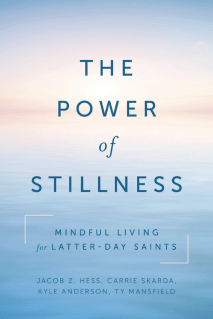
Power_of_StillnessI recently finished the book, The Power of Stillness—Mindful Living for Latter-day Saints.  I purchased the book at Deseret Book and listened to it on Deseret Plus Audio.  It is great at showing the consistencies between the gospel of Jesus Christ and the traditions of Eastern mindfulness.  And it makes studying these concepts more mainstream for me. 

Compared to living in crisis mode and survival mode, this way of being is much less frantic.  It feels so good to just slow down and be still.  And it’s true, as I let go of the need to be perfect, I feel better about myself, God, and my fellowmen.  

To be continued . . . with Part 58

Confessions of a Recovering Perfectionist – Part 56

The Warrior Heart Boot Camp

Lodge wideA week ago I was in Big Canyon in Utah, not far from Coalville and Park City.  I was attending the Warrior Heart Boot Camp.  It was a life-changing three days.  

In Part 48 of my blog from last March, I talked about this experiential weekend retreat.  After I went to the March retreat, I thought, “Well, been there, done that.” And I figured I had gotten what I came for and was done with it.  But after several months I could tell that I was losing some of what I had gained. So when I saw that they were holding another one in November, I felt the tug at my heart.  I prayed to know if it was OK to attend and felt an assurance that it would be a good choice. I registered for the weekend and looked forward to it.  

But during the weeks leading up to the weekend, I had bouts of cold feet, wondering if it was what I should be doing.  I found myself re-thinking the decision—I would need to take vacation time away from work, and the registration fees could be used for other pressing expenses.  Did I really need to attend a 2nd time?  Couldn’t I get the same thing if I just spent some extra time with God and read the book again?  

It reminded me of when I was serving my mission years ago.  We would be teaching someone and had committed them to baptism.  Then in the days leading up to the baptism, they would experience trials and adversity.  The evil one was trying to prevent them from being baptized. Some saw the problems as a sign that they were about to make a big mistake and God was trying to send them a message.  Others recognized the tactics of the enemy and continued strong.  

Since the March retreat, I’ve become more convinced of Satan’s efforts to take me out.  (See my post from last July.)  We’re in an all-out war for the souls of men.  

Last month in Conference, Elder Bednar said:
Satan “is the enemy of righteousness and of those who seek to do the will of God.” All day, every day, his only intent and sole purpose are to make the sons and daughters of God miserable like unto himself.

In that same Conference, Elder Stevenson taught:
Satan, the father of lies and the great deceiver, would have us question things as they really are and either ignore eternal truths or replace them with something that appears more pleasing. “He maketh war with the saints of God” and has spent millennia calculating and practicing the ability to persuade God’s children to believe that good is evil and evil is good. May we recognize Satan’s deceptions for what they are. May we withstand and see through the lies and influences of the one who seeks to destroy our souls and steal from us our present joy and future glory.

Giant SwingI attended again and had a different, but similarly powerful experience.  It was healing on deeper levels than the first time around.  I made stronger connections with good men who have my back in the battles I fight.  I left with a solid resolve and the skills to manage my perfectionism and to place the Lord at the center of my life.  

So now I’m putting in a plug for this retreat.  If you know a man who has been wounded in the battle of life, and could use some healing, consider inviting him to check into the Warrior Heart Boot Camp coming up in May 2020.  There’s also a version for women, called the Heart of a Woman Retreat coming up in February 2020.  Consider it.  

[Photo:  On the Giant Swing during adventure time.  In this photo, it looks quite tame because Im at the bottom of the oscillation, but it’s actually pretty intense!  It provides a spectacular view of the valley.]

To be continued . . . with Part 57

Confessions of a Recovering Perfectionist – Part 55

General Conference 

As I usually do, I’ve included here are some of my main takeaways from the General Conference addresses this month, that resonated with me around my perfectionism.

From Elder Dieter F. Uchtdorf

Elder UchtdorfIf you hesitate in this adventure because you doubt your ability, remember that discipleship is not about doing things perfectly; it’s about doing things intentionally. It is your choices that show what you truly are, far more than your abilities.

Even when you fail, you can choose not to give up, but rather discover your courage, press forward, and rise up. That is the great test of the journey.

God knows that you are not perfect, that you will fail at times. God loves you no less when you struggle than when you triumph.

Like a loving parent, He merely wants you to keep intentionally trying. Discipleship is like learning to play the piano. Perhaps all you can do at first is play a barely recognizable rendition of “Chopsticks.” But if you continue practicing, the simple tunes will one day give way to wondrous sonatas, rhapsodies, and concertos.

Now, that day may not come during this life, but it will come. All God asks is that you consciously keep striving.

From Sister Reyna I. Aburto

Sister AburtoA friend described it this way: “Since my early childhood, I have faced a constant battle with feelings of hopelessness, darkness, loneliness, and fear and the sense that I am broken or defective. I did everything to hide my pain and to never give the impression that I was anything but thriving and strong.”

My dear friends, it can happen to any of us—especially when, as believers in the plan of happiness, we place unnecessary burdens on ourselves by thinking we need to be perfect now. Such thoughts can be overwhelming. Achieving perfection is a process that will take place throughout our mortal life and beyond—and only through the grace of Jesus Christ.

In contrast, when we open up about our emotional challenges, admitting we are not perfect, we give others permission to share their struggles. Together we realize there is hope and we do not have to suffer alone.

President Henry B. Eyring quoted the prophet when he said:

President Nelson went on to give us this encouragement in our efforts to become holier: “The Lord does not expect perfection from us at this point. … But He does expect us to become increasingly pure. Daily repentance is the pathway to purity.” 

To be continued . . . with Part 56

Confessions of a Recovering Perfectionist – Part 54

The Issue of Identity

For some time, I’ve been very interested in the root causes of depression, anxiety, addiction, eating disorders, perfectionism, etc.  As I’ve learned more about these and other issues, I’ve come to believe there is a common basis for the development of so many challenges that cause distress and suffering.  Aside from physiological causes, like a chemical imbalance or a broken gland, I’m convinced that the culprit is a misunderstanding of identity. 

Screen Shot 2019-09-29 at 7.43.38 PMI’m a fan of Kurt Francom’s LeadingSaints, a collection of resources aimed to aid church leaders in better fulfilling their callings.  Each year, a virtual summit is held around a certain topic and experts are invited to share their ideas and research.  Earlier this month, the summit was “Liberating Saints: The Online Conference That Will Help Latter-day Saints Support and Lead Those Who Struggle with Pornography.”

Having served as a bishop, I’m aware of the weighty challenge pornography plays in the lives of many individuals.  So I was interested in the topic. I viewed/listened to several of the interviews. One underlying message I heard repeated was: Rather than shame and berate those with pornography problems, we need to help them understand their true identity.  If they really understand how valuable they are as children of a loving Father in Heaven, the problem is significantly diminished.  

I’ve recently delved into the issue of anxiety and how prevalent it is.  Again, aside from physiological causes, I believe healing occurs when a person realizes his worth as a child of God.  

Parents guideThis morning at church we learned about a new initiative for children and youth.  Six outcomes of the new approach are outlined in a guide for parents and leaders. The first bullet point is that the program will help children and youth “Know their eternal identity and purpose.”  

The first phrase in the Young Women Theme is: “We are daughters of our Heavenly Father . . .”  

The adversary is cunning and organized (see my post from July).  If he can get a child to doubt her divine identity, then he doesn’t have to tempt very hard to keep her from progressing.  His believable lies are easily taken in.  

I speak from personal experience here.  My perfectionism was rooted in faulty core beliefs about my self-worth and potential.  Then shame took hold and the lies became ingrained.  

I’m finding that the more I discover my true identity, the less I struggle.  It’s like peeling back layers of falsehood that were keeping me bound down. As I embrace truth and light I gradually emerge from darkness and captivity—not as a perfect person, but as one with divine capacity.  

To be continued . . . with Part 55

Confessions of a Recovering Perfectionist – Part 53

The “Act As If” Principle

My mission president taught us the “act as if” principle.  If you want to be dedicated and faithful, act as if you already are.  If you want to be happy and optimistic, act as if you are. I liked that, but it was difficult.  Because of my perfectionism, I usually felt like I wasn’t measuring up. But I put on the façade that I was doing okay.  So it was an act, since I didn’t really feel good about myself.  

Story of my life.

I once took a Theater Arts class at BYU-Idaho called “Actors and Emotion” which focuses on methods for generating emotional experiences while performing.  We learned how to conjure up emotions.  If I wasn’t feeling sad, I could generate that emotion in myself.  It seemed artificial.  If I were actually an actor it would probably be useful.  But because I’m not an actor I didn’t feel good about creating sadness or anger or joy, because it didn’t seem honest.  

Screen Shot 2019-09-01 at 2.00.09 PMBy putting on a happy face and smiling, I’ve been criticized (and I’ve criticized myself) for not being authentic.  However, scriptures teach me to “be of good cheer” (Matt 9:3, D&C 68:6, Acts 23:11, Matt 14:27, D&C 61:36, John 16:33).  I love the teaching that we should “cheerfully do all things that lie in our power; and then may we stand still, with the utmost assurance, to see the salvation of God, and for his arm to be revealed” (D&C 123:17).  

So is it OK for me to smile even though I’m going through trials?  Is putting on a happy face like burying my head in the sand or putting on blinders?  

In my Come, Follow Me studies this month, Paul admonished me to “put ye on the Lord Jesus Christ.”  What does that mean?  Can I put Him on, like I would put on a piece of clothing while getting dressed in the morning, and then throughout the day try to act as he would act?  If I were to put Him on as a mask, would I find myself interacting with others in a more Christlike way?  And then after years of wearing Him daily, when I eventually take off the mask, would I find that I’ve taken on His image in my countenance?  

BondsI’m currently re-reading the book “Bonds That Make Us Free” by C. Terry Warner, of the Arbinger Institute.  Near the end of Chapter 11 is this passage:

Behind all this discussion about what we can do to facilitate our own change of heart stands this simple question:  Since we cannot bring about a change of heart in ourselves directly, what can we do directly that will indirectly bring about a change of heart?  The answer is this: Even if we find ourselves unable to do the right thing with concern, compassion, or love, we can nevertheless do it because it is right.  

Pres. Russell M. Nelson taught:  “The joy we feel has little to do with the circumstances of our lives and everything to do with the focus of our lives.”

So if I can focus on gratitude and peace and joy, even when I’m living in difficult circumstances, I’ll be more apt to find those blessings.  I can choose to act as if I’m happy because it’s the right thing to do.  And it will become a self-fulfilling prophecy.  Men are that they might have joy, even in the midst of adversity.  

To be continued . . . with Part 54

Confessions of a Recovering Perfectionist – Part 52

A World at War

war in heavenI was born into a world at war.  I’m not trying to sound dramatic.  According to scripture, before I was born, there was war in heaven.  Adam and his angels fought against the dragon, or Lucifer.  Lucifer and his angels fought and lost the battle.  He, and a third of the hosts of angels fell and were cast down to the earth, never to receive bodies, and to spend their time trying to get the rest of us to fall also, to make us miserable, like themselves.  

So I was born into a fallen world, a lone and dreary, telestial world removed from the presence of my Father, God.  A world of pain and afflictions, thorns and briars, trials and tribulations.  Those trials and afflictions can be useful, if they bring me back to God.  

At a young age, I was wounded.  No, I wasn’t physically abused.  But I began to take on the culture around me that told me I wasn’t enough, that I wasn’t good and valuable.  And each time I was wounded, I made agreements with myself that limited my ability to become all that God wanted me to be.  

When I did this growing up, I internalized many beliefs about myself that I thought were true.  But now that I better understand the influence of the adversary in our lives, I can see that these were lies, whispered in my ear by the father of lies.  He made those agreements with me so he could limit my potential. Not good enough. Not smart enough or talented enough.  Unworthy.  Unloveable.  Can’t change.  Stuck like this forever.  Never get it right.  Never amount to much. 

It’s interesting that when these lies are ingrained in us in our formative years, at an impressionable time, it’s hard to counteract them.  If I’ve gone through years believing that I’m a disappointment to God and others, even if people later tell me otherwise, I’ve got that agreement and it’s difficult to break through that.  

When I say that we’re in a world at war, does that sound like I’m just trying to be sensationalistic and to focus on the negative?  Is Satan really that strong and determined?  Yes, he is strong and determined.  No, I’m not just being sensationalistic.  

Jesus himself said that the thief (meaning Satan) cometh to steal, to kill, and to destroy (John 10:10).  Not just to bully us around a bit, but to steal our happiness, to kill our faith, to destroy our hope. 

The evil one has had thousands of years to practice his tactics and billions of people to practice on.  He has improved and diversified his fighting weapons. He has become really, really good at what he does. President Spencer W. Kimball taught that the fight against Satan and his forces “is not a little skirmish with a half-willed antagonist, but a battle royal with an enemy so powerful, entrenched, and organized we are likely to be vanquished if we are not strong, well-trained, and watchful.” 

Just a few months ago, President Russell M. Nelson said in General Conference:  “Satan knows who you are and who you were premortally, and he understands the work that must be done before the Savior returns. And after millennia of practicing his cunning arts, the adversary is experienced and incorrigible.”

In that same General Conference, Elder Ronald A. Rasband taught:  “Brothers and sisters, we are at war with Satan for the souls of men. Since [our pre-earth life], the adversary’s minions have been fighting the faithful who choose the Father’s plan.

Satan knows his days are numbered and that time is growing shorter. As crafty and cunning as he is, he will not win. However, his battle for each one of our souls rages on.

devil earSatan is a subtle snake, sneaking into our minds and hearts when we have let our guard down, faced a disappointment, or lost hope. He entices us with flattery, a promise of ease, comfort, or a temporary high when we are low. He justifies pride, unkindness, dishonesty, discontent, and immorality, and in time we can be ‘past feeling.’ The Spirit can leave us. ‘And thus the devil cheateth their souls, and leadeth them away carefully down to hell.’” 

So in the past, my tendency was to blame myself for my weaknesses.  If my wife and I had a disagreement.  If I yelled at one of my kids.  If I felt fearful about my ability to succeed.  But knowing what I do about the plan of the devil, I’m better able to recognize his attempts to influence me.  And that changes my whole feeling about myself.  I’m not at war with my true self.  I’m at war with the false self, that natural man who is an enemy to God.  My true self is good, divine, powerful, a precious son of God.  

The more I am able to live in my true self, the more I recognize the Lord’s influence in my life.  He also whispers to me.  As I learn of Him, I am better able to distinguish His voice.  

And as I start to trust the Lord and come unto Him, he heals my wounds.  He breaks those old agreements, those faulty core beliefs I took on as a child.  I start to experience the mighty change of heart.  I become a new person.  I become converted.  

The scriptures teach me how to protect myself from evil.  “Put on the whole armour of God, that ye may be able to stand against the wiles of the devil. For we wrestle not against flesh and blood, but against principalities, against powers, against the rulers of the darkness of this world” (Ephesians 6:11–12).

As I put on the armor of God, I will protect myself and strengthen my loved ones.  Every time the Nephites went up to battle “in the strength of the Lord,” they prevailed.  As I rely on the strength of the Lord, granted through His atoning grace, I too can be victorious.  I can receive the peace, security, and happiness of being firmly grounded in the gospel, of being converted to Jesus Christ.

To be continued . . . with Part 53

Confessions of a Recovering Perfectionist – Part 51

Be Careful What You Pray For

If you read the end of last month’s post, you know that I’m in a time of trial.  About two months ago, I was feeling like I desired to really have a broken heart and a contrite spirit, and to submit my will completely to God.  I prayed fervently that I could offer my whole soul as an offering to Him. It was two days later that I was hit with a significant challenge.  

Lava InnLast week, I attended a sibling reunion.  I was raised seventh in a family of ten children, five boys and five girls.  We had a reunion where my brothers and sisters and our spouses spent two days at Lava Hot Springs in Eastern Idaho.  As part of the get-together, we had time for each of us to share what we are studying and learning.  

One of my brothers talked about a time a few years ago when he had prayed for whatever would allow him to have God with him more.  Soon thereafter he had a series of strokes that left him with neurological damage, requiring him to relearn many of the simple tasks most of us take for granted; how to speak, walk, read, etc.  He has since made immense progress and is more at peace with his life than ever.  

One of my sisters told of a time as a young mother when she felt she needed to commit herself more fully to the Lord and His purposes.  Within a few weeks she was diagnosed with Type 1 diabetes, which has been a tremendous difficulty for her, but has taught her things she wouldn’t have learned otherwise.  

Elder BednarThe timing is interesting.  Elder Bednar once spoke of the tender mercies of the Lord:  I testify that the tender mercies of the Lord are real and that they do not occur randomly or merely by coincidence. Often, the Lord’s timing of his tender mercies helps us to both discern and acknowledge them. The Lord’s tender mercies are the very personal and individualized blessings, strength, protection, assurances, guidance, loving-kindnesses, consolation, support, and spiritual gifts which we receive from and because of and through the Lord Jesus Christ.  Faithfulness, obedience, and humility invite tender mercies into our lives, and it is often the Lord’s timing that enables us to recognize and treasure these important blessings. I testify that the tender mercies of the Lord are available to all of us and that the Redeemer of Israel is eager to bestow such gifts upon us. Each of us can have eyes to see clearly and ears to hear distinctly the tender mercies of the Lord as they strengthen and assist us in these latter days.

Notice that he twice mentioned the Lord’s timing (see italics), which would help us recognize these as the tender mercies of the Lord.  

When I consider these past two months, I wouldn’t have asked for this trial and the associated issues.  But now I realize that it is a tender mercy. It has drawn me closer to God. I’ve become more aware of some parts of me that need healing.  So I’m on that journey.  I’m experiencing a miraculous, perfecting, refiner’s fire.  

To be continued . . . with Part 52

Confessions of a Recovering Perfectionist – Part 50

Stepping into Uncertainty

HafensEarlier this month, Elder Bruce C. Hafen and his wife Marie came to the BYUI campus to speak at an Academic Forum.  They also met with faculty in a separate meeting. They have recently written a new book called, “Faith is not Blind,” and sent Chapter 2 to all faculty so we could be prepared for their message.  I was enthralled with the chapter and quickly finished the whole book. One of my favorite chapters is entitled “Productive Ambiguity.”  

I’ve always had a hard time dealing with ambiguity, because of the need to be “in control.”  Typical of perfectionists is that we are planned and organized. We don’t like surprises and are not impulsive.  We like security and are low-risk.

The Hafens teach that on the other side of complexity is simplicity.  They quote Oliver Wendell Holmes, the great American judge. He said, “I would not give a fig for the simplicity on this side of complexity. But I would give my life for the simplicity on the other side of complexity.”

There’s a stage in our personal development, where we’re kind of innocent.  Our ideas are unchallenged.  And as we grow, it’s a natural process that we will encounter new thoughts, new people, new experiences.  And that can be very challenging.  That is the complexity Holmes is talking about.  People sometimes get stuck in that complexity.  They never get out, their hearts are hardened, and life becomes really difficult.  What Holmes says to us is that maybe the complexity actually makes it possible for us to arrive at a place of informed faith.

If I sit in comfort and naïveté, I’m untested and inexperienced.  But if I am willing to go through complex issues and trials, I can achieve a simple trust born of experience.  

Miller_ScottAlso earlier this month I read a BYU devotional talk by Scott Miller called “Humble Uncertainty.”  Here are a few of my favorite parts:

Life itself is very much like college. There may be times when we wish for the tests to be simplified or waived altogether and when we forget that life is a complex system designed by loving Heavenly Parents to make us into better people and prepare us for an eternity of expanding opportunities. Sometimes, when we pray to have our trials end quickly, we are like first-year students sending home pity-me texts. If God were to immediately swoop in and rescue us, eternity itself might just prove to be something of a basement experience.

Instead, God, like other wise parents, knows that great things will come out of the difficulties and challenges we face. He knows our eternal identity and potential. We, on the other hand, are often clueless about that identity and live forever perched at the edge of a dark, inscrutable path we call the future. We cannot see what lies ahead, which can make our journey discouraging, if not utterly terrifying.

These things we fear have their positive sides too, and we should not be so consumed by our fears and uncertainties that we abandon hope and never move forward. There was a reason Moses, Lehi, and Brigham Young were all commanded to leave comfort and security and strike off into the wilderness. That is where the burning bush, the Liahona, and Zion were awaiting. When we muster the faith to confront our doubts and fears by venturing forward into the dark unknown, we may learn that simple faith might be as fragile as starlight but that it can also guide our journey, fixed as the North Star.

This hits home to me because right now, I’m facing a situation where I have no control over the outcome.  Without going into detail, I feel like I’m stepping into the darkness and I’m forced to trust the outcome to God.  It’s uncomfortable. But then, as the saying goes, there’s no growth in the comfort zone and no comfort in the growth zone.  The trial of my faith comes in the uncertain moments, not when I know exactly what I’m doing.  As I go forth, like Nephi, not knowing beforehand what I will do, my faith is strengthened and I grow in my discipleship.  

To be continued . . . with Part 51

Confessions of a Recovering Perfectionist – Part 49

General Conference

As usual, this post will highlight teachings from General Conference earlier this month, that impress me as being useful for those of us who are perfectionistic.  

Conf CtrThe first one is by Becky Craven.  She taught:  “It’s impossible to live a perfect life. Only one man was able to live perfectly while dwelling on this telestial planet. That was Jesus Christ. Although we may not be perfect, brothers and sisters, we can be worthy: worthy to partake of the sacrament, worthy of temple blessings, and worthy to receive personal revelation.”

Next is one by Sharon Eubank.  Her talk was about staying connected to Jesus Christ—our source of light.  She shared this hopeful testimony:  “I testify you are beloved. The Lord knows how hard you are trying. You are making progress. Keep going. He sees all your hidden sacrifices and counts them to your good and the good of those you love. Your work is not in vain. You are not alone. His very name, Emmanuel, means ‘God with us.’ He is surely with you.”

Kim B ClarkBut my favorite talk of the whole conference was by Elder Kim B. Clark.  Look at what he taught:  “When the Lord calls [us] to ‘look unto me in every thought’ and ‘behold the wounds’ in His resurrected body, it is a call to turn away from sin and the world and to turn to Him and love and obey Him. It is a call to teach His doctrine and do His work in His way. It is, therefore, a call to trust Him completely, surrender our will and yield our hearts to Him, and through His redeeming power become like Him.

“…if we look unto Jesus Christ, He will bless us to be humble, meek, submissive, full of His love. And we will bring the joy and blessings of His gospel and His Church to our families and our brothers and sisters on both sides of the veil.”

President Russell M. Nelson has called us to look unto Jesus Christ in just this way: “There is nothing easy or automatic about becoming such powerful disciples. Our focus must be riveted on the Savior and His gospel. It is mentally rigorous to strive to look unto Him in every thought. But when we do, our doubts and fears flee.”

Rivet is a great word. It means to fasten firmly, to attract and hold completely. We rivet our focus on Jesus Christ and His gospel by living our covenants.

When we live our covenants, they influence everything we say and do. We live a covenant life full of simple, everyday acts of faith that focus us on Jesus Christ: prayer from the heart in His name, feasting on His word, turning to Him to repent of our sins, keeping His commandments, partaking of the sacrament and keeping His Sabbath holy, worshipping in His holy temple as often as we can, and exercising His holy priesthood to serve God’s children.

These acts of covenant devotion open our hearts and minds to the redeeming power of the Savior and the sanctifying influence of the Holy Ghost. Line upon line, the Savior changes our very nature, we become more deeply converted unto Him, and our covenants come alive in our hearts.

The promises we make to our Heavenly Father become rock-solid commitments, our deepest desires. Heavenly Father’s promises to us fill us with gratitude and joy. Our covenants cease to be rules we follow and become beloved principles that inspire and guide us and rivet our focus on Jesus Christ.

One of the reasons I like this so much is because he not only tells us to “look unto me in every thought,” but he also tells us how.  Often, I read or hear that I need to do or be something—such as “be Christlike” or “give your heart to Christ”—but I’m not told how to do it.  And so, for a perfectionist, Elder Clark’s teaching is great—not so we can see it as a checklist of things to do, but so we can know where to focus our energies and priorities.  

To be continued . . . with Part 50