
The Spacesuit
I can relate to this concept of “the spacesuit,” which a friend of mine shared. It helps me to view my own emotions and frustrations of life from a new perspective.
When we come into this world as infants, we are helpless and totally dependent on others for our survival, not only physically for food and sustenance, but also emotionally for emotional needs that are a bit less tangible than the physical needs we have. As children, we have no way of understanding what our needs are, and therefore, no way of clearly communicating them to others when they’re not being met.
So we need our attachment figures—other people—to be able to attune and sense our needs in order to meet them. This is like that sense that the parent might develop of attuning to different types of cries their child makes that indicate different needs: one cry for food, one cry to just be held. Unfortunately, that attunement and meeting of the child’s emotional needs doesn’t always happen. This can occur for a variety of reasons and in a variety of ways. And likely, no matter how good or caring or loving our parents were, it’s probably the case that they weren’t able to meet all of our emotional needs. This is not to blame parents or society (even though it might feel satisfying to say it’s their fault that I’m this way). It’s simply the way things happened.
 Again, for a variety of reasons some of those core needs we had as children were just not met. So the child, not having their needs met, does whatever it can to adapt to its environment, to survive. You can think of these adaptations as like the building of a makeshift spacesuit, in order to be able to breathe. Not even knowing you were making it, you were building the suit, just grasping for whatever seemed to work to help you be able to breathe in your environment. And somehow it allows you to survive, maybe through a lot of pain, but survival was achieved nonetheless. The spacesuit did its job.
Then, as you grow older you continue to wear the spacesuit, believing on a deep (and likely subconscious) level that you really need the spacesuit in order to breathe. You find yourself wearing this tattered, rusty spacesuit in an environment where you don’t actually need it. You are no longer in that environment in which it was created (without your conscious awareness of it even being created). Now, it’s actually becoming more and more constricting and heavy, making it hard for you to breathe. The spacesuit is creating this existence of an ongoing struggle, a battle against life for survival: “If only I keep wearing the suit maybe one day I’ll finally get whatever it was that I never got.”
All along, the child that you once were whose emotional needs went unmet has remained a part of you. This is your inner child and it continues to call out, to cry, to scream, just trying to receive the care and acceptance that it deserves, simply for being human. Not for its accomplishments, or its good deeds, for how cool it is, how athletic is, how smart it is, how attractive it is. Not for anything except for just being alive, just for being a person.
This is the deepest and most true form of acceptance and love that we all, at our core, crave and need, and that many of us have never really felt deeply in our bones. And since many of us never receive it, a part of our spacesuits is the belief that we don’t deserve it, that we’re not worthy of it. That if we show others who we really are, they would not accept us and love us. So we keep wearing the spacesuit.
What can happen is that we grow to treat our own inner child the same way it was treated by others. We ignore it, we tell it to be quiet, we get mad at it: “Shut up! Why are you being such a baby! You are so stupid! Why can’t you just be normal?!” We can develop a strong inner critic voice that’s a part of the spacesuit. If we can judge and criticize ourselves really harshly, then maybe we can take away the power from other people to do so. If we were to expose who we really are—our inner child—to show that would be even more painful if they were to respond to us in this way. So we might develop a strategy of a really harsh critical voice aimed at ourselves.
You might reflect on how you respond to your own inner child in moments where you feel overwhelmed or really anxious or angry or sad. What does that inner critic voice say to those sides of you that come up?
Here’s where the paradigm shift can take place. Anytime that you experience a really strong powerful and overwhelming emotion, imagine this as your own inner child calling out and trying to communicate with you. And then think of how you respond. Imagine this. When the child calls out to you if they are really sad or angry or anxious, and you respond in a way that is critical and harsh and pushes them away.
 Or could you respond in a way that is compassionate, where you are just there for them and you care for them, maybe in a way that you never received?
This is the shift that you can make. You can notice your own feelings coming up. Those feelings are valid. Notice the urge to criticize yourself, and then shift into a stance of compassion—even if it’s just for a moment—of caring for this side of you.
Notice this side of you. Allow it some space to come up. And then this other side, the spacesuit side that has developed—your grown adult, organized, “has everything together” version can respond to your child self as a loving and caring parent.
See if the spacesuit version of yourself can step aside for a moment (knowing that it’ll come back), and allow the child version of you to come up and have a full voice for a moment. What would the child say? What would he/she do?
Who you are at your core is more than enough, and is totally worthy of love and acceptance, just for being the person, the child of God that you are.
To be continued . . . with Part 59
 For the past couple of years, I’ve been interested in learning more about mindfulness and meditation. About a year-and-a-half ago, I took a
 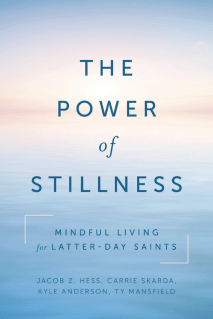 I recently finished the book,
  A week ago I was in
  I attended again and had a different, but similarly powerful experience. It was healing on deeper levels than the first time around. I made stronger connections with good men who have my back in the battles I fight. I left with a solid resolve and the skills to manage my perfectionism and to place the Lord at the center of my life.
  If you hesitate in this adventure because you doubt your ability, remember that discipleship is not about doing things perfectly; it’s about doing things intentionally. It is your choices that show what you truly are, far more than your abilities.
 A friend described it this way: “Since my early childhood, I have faced a constant battle with feelings of hopelessness, darkness, loneliness, and fear and the sense that I am broken or defective. I did everything to hide my pain and to never give the impression that I was anything but thriving and strong.”
 I’m a fan of Kurt Francom’s
  This morning at church we learned about a new initiative for children and youth. Six outcomes of the new approach are outlined in a guide for parents and leaders. The first bullet point is that the program will help children and youth “Know their eternal identity and purpose.”
  By putting on a happy face and smiling, I’ve been criticized (and I’ve criticized myself) for not being
  I’m currently re-reading the book “Bonds That Make Us Free” by C. Terry Warner, of the Arbinger Institute. Near the end of Chapter 11 is this passage:
 I was born into a world at war. I’m not trying to sound dramatic. According to scripture, before I was born, there was war in heaven. Adam and his angels fought against the dragon, or Lucifer. Lucifer and his angels fought and lost the battle. He, and a third of the hosts of angels fell and were cast down to the earth, never to receive bodies, and to spend their time trying to get the rest of us to fall also, to make us miserable, like themselves.
  Satan is a subtle snake, sneaking into our minds and hearts when we have let our guard down, faced a disappointment, or lost hope. He entices us with flattery, a promise of ease, comfort, or a temporary high when we are low. He justifies pride, unkindness, dishonesty, discontent, and immorality, and in time we can be ‘past feeling.’ The Spirit can leave us. ‘And thus the devil cheateth their souls, and leadeth them away carefully down to hell.’”
  Last week, I attended a sibling reunion. I was raised seventh in a family of ten children, five boys and five girls. We had a reunion where my brothers and sisters and our spouses spent two days at Lava Hot Springs in Eastern Idaho. As part of the get-together, we had time for each of us to share what we are studying and learning.
  The timing is interesting.
  Earlier this month, Elder Bruce C. Hafen and his wife Marie came to the BYUI campus to speak at an Academic Forum. They also met with faculty in a separate meeting. They have recently written a new book called, “
 Also earlier this month I read a BYU devotional talk by
  The first one is by
  But my favorite talk of the whole conference was by
