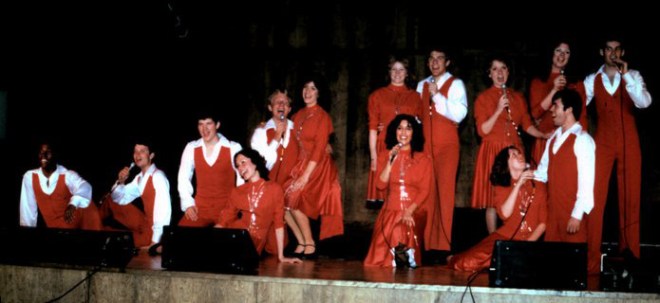
Wild at Heart
If you heard my devotional talk from last October, or if you read Part 35 of this blog, you know that I have had a difficult time my whole life trying to feel God’s love for me. I’m sure part of that is because I have kept my heart somewhat closed and protected. So in this post I’m going to share an experience I had that significantly opened my heart to His love.
 A few years ago, a friend suggested I read the book Wild at Heart: Discovering the Secret of a Man’s Soul, by John Eldredge. I did, and found the book fascinating.
From the back cover of the book: “Every man was once a boy. And every little boy has dreams, big dreams, dreams of being the hero, of beating the bad guys, of doing daring feats and rescuing the damsel in distress. But what happens to those dreams when we grow up? Walk into most churches, have a look around, and ask yourself: What is a Christian man? Without listening to what is said, look at what you find there. Most Christian men are . . . bored. Wild at Heart, invites men to recover their masculine heart, defined in the image of a passionate God.”
However, at that time I wasn’t in a place in my own journey to really embrace the concepts. So I kept the book on my shelf and periodically revisited the ideas.
Then last fall I listened to a podcast on Leading Saints called Wild at Heart in Church Leadership: An Interview with Doug Nielsen. The podcast reignited in me some of the things I had read and also applied it to our elders quorums. While progress is being made in ministering to men in the Church, it seems that a lot of men are still in checklist mentality, living in should’s and ought to’s rather than living from a place of passion, connection, honesty, and vulnerability. (See this article by my colleague, Sheldon Lawrence, A Quorum of Strangers: On the Isolation of Mormon Men.)
I subscribe to the Leading Saints emails and I received one where Kurt Francom (owner of Leading Saints) described attending a retreat based on the Wild at Heart book and concepts. The Warrior Heart boot camp was an opportunity to actually implement those concepts personally.
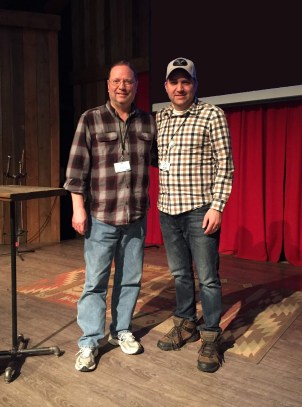 As I read of Kurt’s experience there, my own heart yearned for a similar experience. I looked into the possibility of attending. Things fell into place and I found myself in Wanship, Utah earlier this month. For three days, I was continually presented with the idea that God loves me—unconditionally. For part of the first day my cold, closed heart held on tightly, skeptical that God could really love me that way. But gradually I was convinced to let go of the hardness and the Lord broke down the barriers I had built up many years ago. He offered His Love to me over and over, and it sank deep into my heart. It was a truly transformational time for me.
Why this retreat worked for me:
(First, let me say that the retreat isn’t for everyone. I’m only sharing my own personal experience. I’m not advertising it and I don’t get a commission if others attend.)
- I was in a place apart from “the world” in the mountains where the beauties of nature were all around me. God’s handiwork was so evident. It was scenic and glorious.
- We were asked to leave our phones and other devices in our cars, so we could unplug from the outside world and not be distracted.
- The sessions were presented by men who have worked the concepts themselves. They have walked the walk, and were very genuine and honest. The ideas presented were scripturally based and not just therapeutic.
- After each session we had alone time with God. Just Him, me, and my journal. No putting on a front or trying to impress anyone. Nothing else to do but to talk with Him. Share my fears, my shame, my sadness, my hopes, my passion, my resolve. This is where I felt His love in my heart most convincingly.
- I experienced a real sense of brotherhood and supportiveness from the other men there. Not just from those who were facilitating the weekend, but from those who were, like me, attending for the first time. I really only knew one other man there, yet in a matter of hours, previous strangers were sharing and interacting like old friends. It was great to connect with them authentically.
- In the past, when I had felt God’s love, it seemed like it was short-lived. Soon after, I’d start doubting whether I actually felt it or not. But for the duration of the retreat, the feeling was constant. There was no mistaking or denying it. In fact, part of the reason I’m writing about it here, is so that if I ever doubt His love in the future, I’ll have this as a reminder.
As I drove home Saturday night, I wondered what it would take to get the same feeling in our elders quorums.
To be continued . . . with Part 49
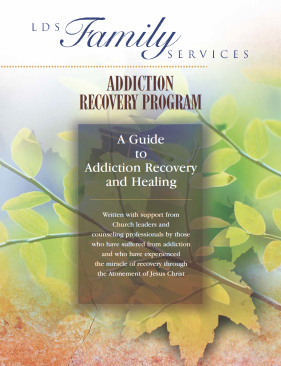 Years ago, when the Church realized that members needed help dealing with addiction, they looked at what worked and didn’t work. In conjunction with LDS Family Services (then known as LDS Social Services) the Twelve Steps of Alcoholics Anonymous were adapted into the framework of the doctrines, principles, and beliefs of the Church. This was back in the late 1990s. Working with those who had experienced recovery, the first ARP (Addiction Recovery Program)
  It might work with addicts, but it’s not limited to them; everyone everywhere can benefit from it. We all need to go through our Step 8s, our Step 3s, our Step 6s. If we believe it is only for people who are addicts, we are missing the message—the whole Grace message of Christ’s sacrifice. We’ll miss seeing that we need Christ in our own selves. But how poor a gauge we are of our own health. That’s why we go to doctors. They can give us doctor’s orders to change certain behaviors that are self destructive. We don’t tend to find that out ourselves. Hence, the need for a program.
  Satan strives to keep me stuck, to stop my progress. He wants me to be damned, like he is. But he is very subtle. He doesn’t make his presence obviously known to me. As
 An example of this might be a character in a video game. I see this character coming toward me with a sword. I need to fight him and get him out of the way so I can proceed in the game. So I pull out my sword and slay him. Or I see a character who has something I want (treasure, essence, a key, power) and if I eliminate him, I can take his possession and move to the next level better equipped to succeed.
  When I see others as real people it results in empathy, respect for them and for myself, feelings of value and worth, safety, and the ability to look past weakness.
 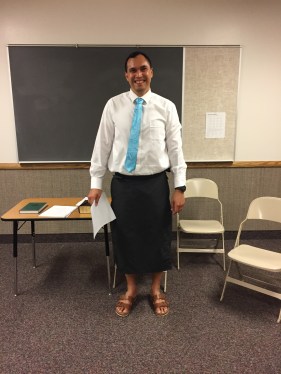 What if someone joined your ward who was from Albania, or Nigeria, or Bolivia or Mongolia? (Or Mars, for that matter.) What if they wore different clothing to church – a sarong or a kilt or a burka or a lavalava, or shorts and sandals? What if a woman showed up with tattoos and body piercings? What if two men showed up who were living a gay lifestyle but who wanted the influence of the gospel in their life? What if an unwed teenager who was obviously pregnant came to Sacrament Meeting? What if someone of a different political persuasion came? What about someone who reeked of tobacco smoke or alcohol? An excommunicated man? A young lady who came home from her mission early? A returned missionary who is addicted to porn? An ex-convict who spent 20 years in prison?
  How would we react if these people showed up at church? Would we escort them back outside? Would we whisper about them behind their backs? Would we avoid them? Or would we go up to them and welcome them, shake their hands, and introduce ourselves.
  I spoke at the weekly devotional at BYU-Idaho this past week. (See the 3rd tab near the top of this page.)
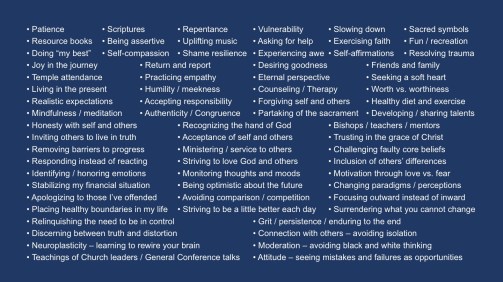 The list of 70 that I showed might seem overly long. If I’d had time to choose one more for the talk, it would have been Counseling / Therapy. It’s a huge area that’s so often overlooked because of the stigma associated with needing to see a “shrink.”
 So we were stuck in Chicago with no incoming or outgoing flights for awhile. The airline had re-booked us on a later flight, but it was cancelled, as well as an even later flight which was also cancelled. The next available flight would leave Tuesday afternoon with a layover in Charlotte, NC, arriving in Rochester on Wednesday afternoon. At that point the tour group would be in Scranton, PA and we would have missed the first two days of sites.
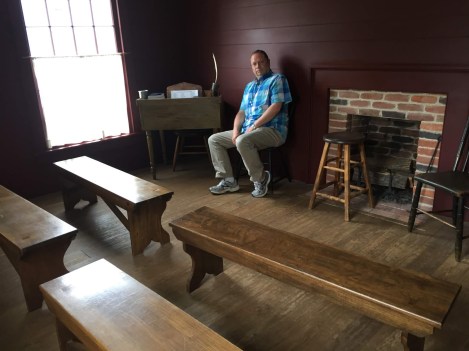 For ten days we visited some of the most significant locations of the early church: Palmyra; the Hill Cumorah; the Sacred Grove; Harmony, PA; Susquehanna; Kirtland; Independence; Liberty Jail; Far West; Adam-ondi-Ahman; Nauvoo; Carthage; and others. We left with some great friends and some great memories, and with strengthened convictions of the restoration, the prophets, and the scriptures. (See the accompanying photo of me at the location of the School of the Prophets in Kirtland, OH.)
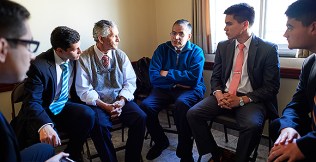 Earlier this month in a meeting with my elders quorum, we had a discussion about some of the challenges that individuals face in life. One man talked about his father, who announced to his family that he was transgender and subsequently left the Church.
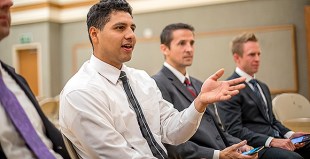 So my hope and request is this: Since everyone has trials, weaknesses, issues, difficulties, and afflictions, instead of thinking and talking about “them,” “they,” and “those who experience [fill in the blank],” think of “them” as “us,” and “we,” because while you’re talking about “them,” “we” are sitting with you in that meeting.
 When I’m in my perfectionism I want God to walk through the door and instantaneously make me complete. I want him to wipe away all my imperfections in one fell swoop.
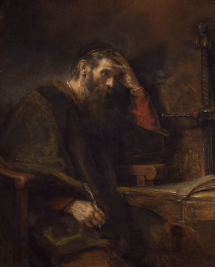 The Apostle Paul was given a “thorn in the flesh,” lest he should be “exalted above measure” (
 When I watched the “