
I serve on the high council in my stake. So most months I speak in one of the twelve wards in Sacrament Meeting. This year my main topic has been the idea of focusing outward instead of inward.
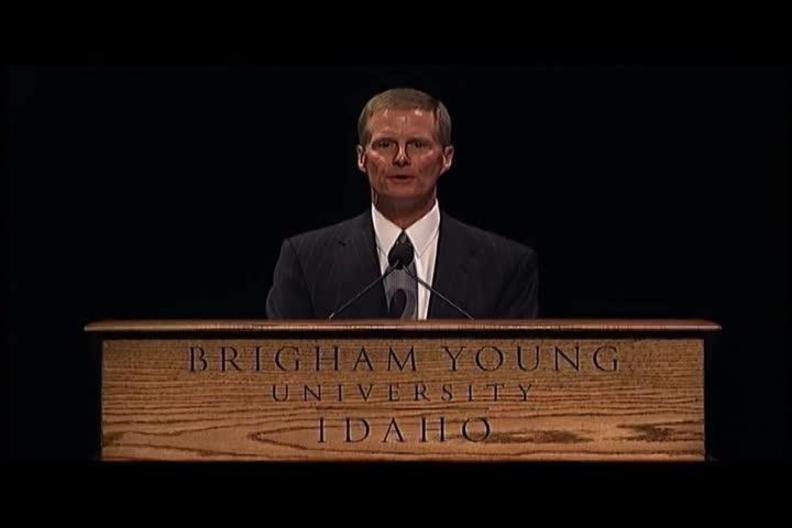 The primary concept is from a talk Elder Bednar gave at BYU-Idaho called “The Character of Christ.” He taught that “Throughout His mortal ministry . . . the Savior of the world turned outward—when the natural man or woman in any of us would have been self-centered and focused inward.” My initial thought when I heard the talk was that if I want to be like Christ, I must focus on others instead of myself. Shouldn’t that be my quest? If I could lose myself in the service of others, then I’d be very Christlike.
 One of the problems with this kind of thinking is that it’s very black-or-white. Can I really spend all of my time focusing on others, and not myself? Is it possible or good to always focus outward? Are there times when we could appropriately focus inward? I believe there are.
If you’ve flown on on airplane you’ll remember one of the instructions you were given: “In the event of a loss of cabin pressure, oxygen masks will drop from the overhead area. Please place the mask over your own mouth and nose before assisting others.”
This is an interesting principle. In the event of an emergency, if I’m going to be able to help the child beside me secure his oxygen mask, I need to first secure my own. If I am going to be able to help my neighbours, I first need to put on my own oxygen mask. What might appear to be a self-serving act is actually the condition for being able to care for others.
You’ve probably also heard concepts like these:
You can’t pour from an empty cup. Take care of yourself first. You cannot serve from an empty vessel. When you take time to replenish your spirit, it allows you to serve others from the overflow.

Self-compassion should be an important aspect of the compassion we show.
Another way to look at self-care is “recharging your battery” so that you can operate optimally.
Stephen R. Covey refers “sharpening the saw.” You can’t cut down a tree very well if your saw is dull.
I believe that there are times when I can appropriately focus inward.
Let’s look at a few examples from the scriptures:
Before he began his ministry, the Savior spend time in the wilderness fasting for 40 days. This was an important part of his preparation to go forth. (Matt 4:1-2.)
Christ told Peter that he should first concentrate on his own conversion, and then he should strengthen his brethren. (Luke 22:32.)
Enos went to hunt beasts in the forest, his soul hungered, and he cried unto God in mighty prayer. His sins were forgiven him because of his faith in Christ. Once he had received his own conversion, he then prayed for the welfare of his brethren—both the Nephites and the Lamanites. He moved from an inward focus to an outward focus. (Enos 1:1-11.)
Because we live in a fallen world, it’s not possible to always have an outward focus. But my focus is an indication of my level of conversion. As I become more like Christ, and develop a character more like His, my tendency will be to focus less on myself and more on others. As I receive the mighty change of heart, my concerns will be more outward than inward.
To be continued . . . with Part 22.











 Imperfect Guy