Confessions of a Recovering Perfectionist – Part 8

As I watched General Conference earlier this month, I listened for particular teachings that might address the kinds of issues and challenges that might benefit us perfectionists.  Here are gems from three of my favorites:


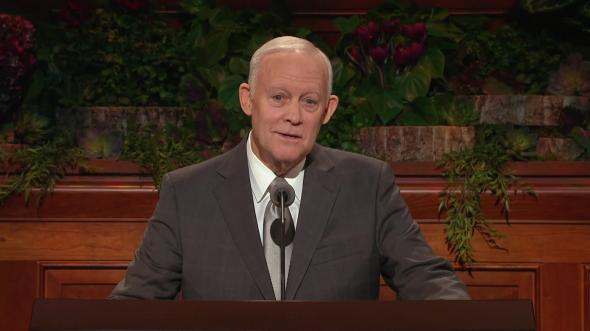
Sister Neill F. Marriott and her family chose this family motto:  “It will all work out.”  She says, “Our family motto doesn’t say, ‘It will all work out now.’  It speaks of our hope in the eternal outcome—not necessarily of present results.  Scripture says, “Search diligently, pray always, and be believing, and all things shall work together for your good.”  This doesn’t mean all things are good, but for the meek and faithful, things—both positive and negative—work together for good, and the timing is the Lord’s.”  


She also taught:  “Some may think they have failed too many times and feel too weak to change . . .  However, as covenant Israel, we don’t just try and try on our own to change.  If we earnestly appeal to God, He takes us as we are—and makes us more than we ever imagined.  Noted theologian Robert L. Millet writes of ‘a healthy longing to improve,’ balanced with the spiritual ‘assurance that in and through Jesus Christ we are going to make it.’”


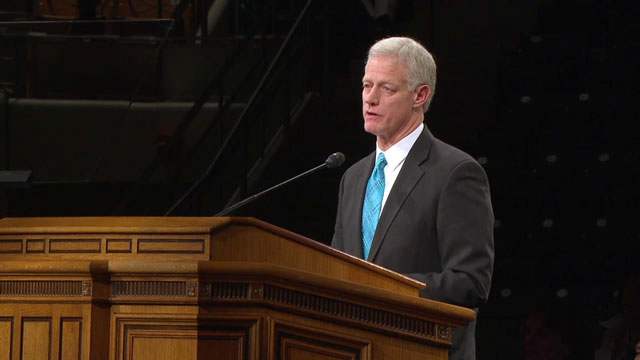
Elder Larry R. Lawrence quoted President Harold B. Lee:  “Every one of us, if we would reach perfection, must [at] one time ask ourselves this question, ‘What lack I yet?’”


“The Holy Ghost doesn’t tell us to improve everything at once.  If He did, we would become discouraged and give up.  The Spirit works with us at our own speed, one step at a time, or as the Lord has taught, ‘line upon line, precept upon precept.’”


“The Spirit can show us our weaknesses, but He is also able to show us our strengths. Sometimes we need to ask what we are doing right so that the Lord can lift and encourage us. . . . Our Heavenly Father knows our divine potential.  He rejoices every time we take a step forward.  To Him, our direction is ever more important than our speed.


“Be persistent, brothers and sisters, but never be discouraged.  We will have to go beyond the grave before we actually reach perfection, but here in mortality we can lay the foundation.  ‘It is our duty to be better today than we were yesterday, and better tomorrow than we are today.’”


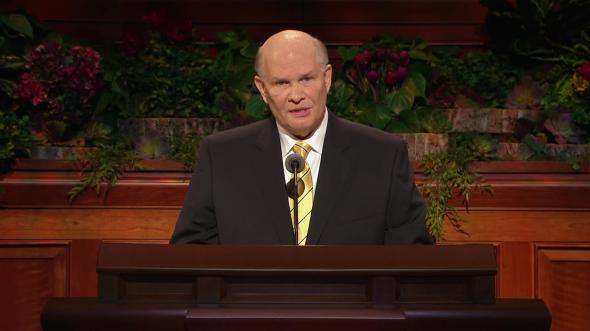
Elder Dale G. Renlund spoke several things that resonated with me.  Because I have experienced the numbing of my emotions, I related to his description that “I developed a kind of emotional distance when things went poorly.  That way, feelings of sadness and disappointment were tempered.”


“I now realize that in the Church, to effectively serve others we must see them through a parent’s eyes, through Heavenly Father’s eyes.  Only then can we begin to comprehend the true worth of a soul.  Only then can we sense the love that Heavenly Father has for all of His children.  Only then can we sense the Savior’s caring concern for them.  We cannot completely fulfill our covenant obligation to mourn with those who mourn and comfort those who stand in need of comfort unless we see them through God’s eyes.”


I guess the reason I like these teachings is because they give me hope—hope that I don’t need to do it all . . . right now . . . on my own.  I love to hear God’s servants.  Their words encourage and uplift me.  They strengthen my faith.  I testify that they speak light and truth.  


To be continued . . . with Part 9.

Confessions of a Recovering Perfectionist – Part 7

One of the interesting things about perfectionists is that most of us don’t even realize our thinking is faulty.  We assume that everyone else feels the same way about striving to be perfect.  


A friend recently shared with me this story:


“When I was a college student, I met regularly with a campus counselor.  On one of our visits, he read to me this narrative:


Patty Perfect hails from Salt Lake City, Utah.  She’’s married and has ten children.  Even though she’’s a stay at home mom, she manages to keep busy.  Her typical day begins around 5:30am when she gets up and reads nine chapters from the scriptures.  After jogging twelve miles, she’’s home in time to make a hearty, healthy breakfast and oversee the practicing of musical instruments by her children.  Once breakfast is over, family scripture study completed, children and husband sent off to school and work, Patty takes the five younger children with her as she does her visiting teaching.  Arriving home in time for lunch, she saves time by also preparing the week’’s dinners in advance while the smaller children teach each other the alphabet.  Then the children go down for naps while Patty has a few moments to herself.  She likes to spend her free time sewing clothes for the whole family and baking whole wheat bread.  As the older children arrive home from school, she treats them to milk and freshly-baked cookies before helping them with their homework and science fair projects. Her favorite time of the day is when she’’s cleaning the house because “cleanliness is next to godliness.”


“The counselor then asked me, ‘What’s wrong with that story?”  I answered, ‘Uh . . . I don’t see anything wrong with it.  It sounds like she’s really got her life in order.   That’s the kind of person I’d like to be!’  He responded, “Well . . . I can see we’ve got work to do.”  


It wasn’t obvious to my friend how totally unreachable the bar was that she had set for herself.


When I was a bishop I had several ward members come to me with these same feelings and I would always give them the pep talk:  “It sounds like you’re being really hard on yourself.  I think you need to be a little more self-compassionate.  You don’t have to be perfect to be worthy . . .”  But it was difficult to apply those same ideas to myself.  It seems that we often can see others as candidates for heaven, but not ourselves.  


For most of my life, I didn’t see my own perfectionism.  I didn’t see my self-expectations as overly high.  The thing that finally helped me to identify perfectionism was the persistent and deep feelings of guilt, shame, and unworthiness.  


Another thing that has helped me is to recognize black & white thinking.  If I were to start to list the expectations I have of myself, I’d probably see words like “always,” never,” “all,” “every,” etc.  It could look like this:  Attend the temple every week.  Visit all of my home teaching families during the first half of the month.  Never engage in gossip or backbiting.  These words show that I’m being extreme in my thinking.  


As I’ve learned to more readily recognize when expectations are unrealistic, I’m able to effectively use “shame resilience” techniques.  And I’m better able to hear the whisperings of the Spirit reconfirming my divine worth.


The Spirit can help us learn to see “things as they really are.”  (Jacob 4:13)

To be continued . . . with Part 8.

Confessions of a Recovering Perfectionist – Part 6

Recently, for our weekly date night, my wife and I attended the popular Disney-Pixar animated film, Inside Out.  We loved it!  Not only was it very entertaining; it was also quite instructional.  It illustrated the significance emotions play in our day-to-day lives.  


Numbing Emotions
In Part 3 of this blog I wrote about the fact that we sometimes tend to numb our emotions, to avoid feeling pain and discomfort.  (See also Of Wounds and Walls in Part 5.)  As children, we were sometimes taught that it’s not OK to express our emotions.  “Don’t be a scaredy cat!”  “Big boys don’t cry!”  “Don’t be angry at your sister!”  So it’s easy to see why it became easier to just suppress those emotions.
I’ve lived the major portion of my life quite numb to my emotions.  It resulted in the inability to connect deeply with others.  


I remember once years ago when a friend of mine, realizing that I had difficulty attaching in relationships, recommended that I read the book “Human Intimacy” by Dr. Victor L. Brown, Jr.  I started reading it and it was like a foreign language, Greek to me.  I had no peg to hang it on.  I got nothing out of it except maybe feeling more shamed.  I was so numb emotionally, I was intellectualizing, trying to understand something in my head, not able to get it into my heart.  Others might try over and over to explain these concepts to me, but for someone so numb, it just doesn’t penetrate.  There’s no way to internalize it.  That was me.  


The Spirit of God Works Through Our Feelings  
Spiritually, there’s a problem with being so numb.  The still, small voice can’t get through very much.  Here’s how it might happen for a perfectionist:


I try to do my best to keep all the commandments.  I do all of the basics religiously — read my scriptures, pray, hold Family Home Evening, attend my meetings, serve others, etc.  And I’m hoping to feel joy.  


But because I’m numb to me emotions, I’m not getting any spiritual nourishment.  Those things become more and more frustrating.  


So I decide that I must need to read an extra chapter in the scriptures every day, fast twice a month instead of just once a month, pray harder, go to the temple more often . . .


I’m doing all of the “primary” expectations, but I’m not getting anything.  I want it to be a cure all but is’t not working.


One of the problems with not being able connect with others, is that I also am not able to connect well with the Lord.  Maybe there’s been a father-injury.  We not only experience that with our earthly fathers, but we also can experience that with our Heavenly Father.  Often times there’s resentment.  


And to avoid feeling pain, we sometimes go into promise-making:  “God, if I do these five things that I’ve been counseled to do time and time again, and do them religiously and without fail (taking that perfectionistic stance), then you will reach down and remove this adversity from me.  And then I’ll know you exist.  Then I’ll be more faithful, more certain in my faith.”


But that doesn’t work very well.  That’s not His way.  


Certainly, in certain circumstances He could do that.  But to develop that intimacy with Him, He wants us to come to Him in meekness, in humility, not demanding certain outcomes.  He wants us to recognize our absolute dependence on Him.  This is at odds with our perfectionism.  We feel like we need to be perfect, to be self-sufficient (self-righteous) before we can approach Him.


The Paradox
I love the teachings of Pres. Uchtdorf about our relationship with God:


“While we may look at the vast expanse of the universe and say, ‘What is man in comparison to the glory of creation?’ God Himself said we are the reason He created the universe! His work and glory—the purpose for this magnificent universe—is to save and exalt mankind (see Moses 1:38–39). … Our Heavenly Father created the universe that we might reach our potential as His sons and daughters.


“This is a paradox of man: compared to God, man is nothing; yet we are everything to God. While against the backdrop of infinite creation we may appear to be nothing, we have a spark of eternal fire burning within our breast. We have the incomprehensible promise of exaltation—worlds without end—within our grasp. And it is God’s great desire to help us reach it” (Dieter F. Uchtdorf, “You Matter to Him,” Ensign, Nov. 2011, 20).

As I learn to identify, honor, and appropriately express my emotions, I open up myself to the possibility of feeling true joy. I also allow myself to feel Gods Spirit more in my life.
To be continued . . . with Part 7.

Confessions of a Recovering Perfectionist – Part 5

I’m on my stake High Council, which means I speak at each of the wards in the stake once a year.  In my preparations for speaking I typically contact the bishop and ask if there is a particular topic he would like me to address.  Usually they say to just talk about whatever I’ve been studying.  I make it a matter of prayer so I can hopefully do the Lord’s will in each instance.  Every time this year so far, I’ve been able to choose my own topic.  And since Perfectionism has been a major part of my study lately, in each ward I’ve felt impressed to speak on Perfection.  


It isn’t your typical High Council talk.  It’s quite soul-baring for me, since I’ve lived in this stake for more than 20 years and know many of these people.  I basically share my story (see Part 1 of this blog) and then supplement it with scriptures and illustrations, as I feel prompted.  


It’s remarkable to see how many people talk with me afterward saying essentially “You really get me,” and asking for a copy of the talk.  So I point them to this blog.  


When I feel that someone understands me, there’s an immediate connection with that person.  In our interactions we can usually skip from square one to square two or three.  So as these people look me in the eye, I see deeper than I normally would.  


Here are a few examples of what has happened as a result of these speaking assignments:


A sister emailed me and said that she “desperately needed” the message.  She suffers from PTSD as well and had been experiencing flare ups.  She was grateful to know that someone else understands some of what she is going through.


A bishop’s wife told me that the talk was “an answer to prayer.”  Their son is very talented and smart.  But it seems like it is “never good enough” for him.  They had known about their son’s challenge for some time, but didn’t have a name for it and didn’t know how to help him.  They had been praying for help.  He has since been meeting with a therapist and is progressing.  


Right after the closing prayer, a young man came up to me and asked if I would give him a priesthood blessing.  I must have hesitated because he said, “Your talk was my life story.  I trust you to give me a blessing, because you understand me.”  I asked, “Right now?”  “Yes,” he replied.  We found a room in the building that was vacant and his wife joined as I gave him the blessing.  Because I have such strong feelings about this issue, I was afraid that I might say what I wanted him to hear and not what the Lord wanted me to say.  But I felt that the words were inspired.  We all cried.  Afterward, we talked for awhile.  I agreed to be a mentor for him and we have met since to discuss his challenges and progress.  (Disclaimer:  I have not received any training as a therapist or a counselor.  So my mentorship is based solely on my own research and experience.)  


One thing I learned from this experience with this young couple:  As much of a challenge as this is for the perfectionist, it is equally challenging for the spouse.  Because I had been numbing my feelings for years, my wife was experiencing a husband who was detached emotionally.  Where does that detachment and lack of connection come from?  


Here’s how the story played out for many of us:


Of Wounds and Walls
Because of childhood wounds, we saw the world as an unsafe place.  And so we built walls to protect us from the pain.  These wounds and walls were often subconscious.  We weren’t aware of what was happening and were too young to understand it.


The wounds caused us to start to numb ourselves to the pain.


The walls caused us to isolate ourselves.  We lost the ability to bond, attach, and connect with others.  We felt flawed, broken, defective, and unlovable.


We moved in to survival mode.


We created false selves—masks, facades, projections of a happy and “good” kid.


We worked hard to appear like everything was OK, like we had it all together.  


All the while, we felt more and more ashamed of who we were.


Learning to Be Authentic
To learn to live authentically, we needed to make changes both internally and interpersonally.


Internally, we needed to become whole within ourselves and accept ourselves totally, rather than repressing, or hiding parts of ourselves. It required the capacity to feel and tolerate the full range of our own feelings, which can sometimes seem conflicting, confusing, and painful.  And it required the ability to integrate these feelings, along with our beliefs about ourselves, others, and the world into a personality that could meet the challenges of life and relationships.


Interpersonally, we needed to develop the ability to be fully present and assertive in relationships to the degree appropriate and to respond out of our genuine selves in those relationships.


This entire process required facing fear in a profound and new way. We had to let down our defenses in order to re–enter internal conflicts that we had previously considered too painful to touch. And we needed to venture into the areas where illogical, uncomfortable, and unpredictable emotions exist.


We then began to carry our newfound assertiveness and clarity into the real world of relationships. We begin to allow others to see our feelings in the present. We become able to reveal ourselves to others and stay in relationships rather than defensively detaching.


To be continued . . . with Part 6.

Confessions of a Recovering Perfectionist – Part 4

Perfectionism is not so much a physical affliction, but an affliction of the mind and the heart.  To recover from this affliction, we need healing in both the heart and the mind.  

Healing in the Heart
About a month ago I had a very emotionally intense experience.  (The experience is a whole ‘nother story, which I may write about at some time in the future.)  It was heart-rending and heart-healing.  I was able to face some core emotions that had been blocking my progress.  As a result, since then, I’ve been better able to recognize the difference between the old stoic intellectually-motivated man, and the new learning-to-be-open-hearted man.  I find myself being more heart-felt in my responses to others.  I enjoy feeling this way.  This is progress.

President Boyd K. Packer taught the following powerful idea: “True doctrine, understood, changes attitudes and behavior. The study of the doctrines of the gospel will improve behavior quicker than a study of behavior will improve behavior.” (Boyd K. Packer, “Do Not Fear,” Ensign, May 2004, 77.)  

I’d like to emphasize the “understood” part of the above quote.  For most of my life I thought that understanding was what happened in my head—intellectually.  But the scriptures teach that understanding really happens in our hearts.  (These scriptural examples were cited by Elder Bednar in a Ricks College Campus Education Week Devotional in June of 1999.)

  • Who hath put wisdom in the inward parts? Or who hath given understanding to the heart? (Job 38:36)
  • My mouth shall speak of wisdom; and the meditation of my heart shall be of understanding. (Psalms 49:3)
  • So that thou incline thine ear unto wisdom, and apply thine heart to understanding. (Proverbs 2:2)
  • Ye have not applied your hearts to understanding; therefore, ye have not been wise. (Mosiah 12:27)
  • . . . but that you should hearken unto me, and open your ears that ye may hear, and your hearts that ye may understand, and your minds that the mysteries of God may be unfolded to your view. (Mosiah 2:9)
  • And the multitude did hear and do bear record; and their hearts were open and they did understand in their hearts the words which he prayed. (3 Nephi 19:33)

So, although I previously had a cognitive knowledge that I’m God’s son and that He loves me, I didn’t really understand it until I started feeling it in my heart.  

Healing in the Mind
We know that the Savior can heal our heartsHe said that He is come to bind up the brokenhearted.  But we also need him to heal our minds.  

When Joseph Smith was in the Liberty Jail, the Lord told him:  “Let virtue garnish thy thoughts unceasingly; then shall thy confidence wax strong in the presence of God; . . .  The Holy Ghost shall be thy constant companion, and thy scepter an unchanging scepter of righteousness and truth.” (D&C 121: 45-46)
I love what Elder Holland has to say about this:  “Let virtue garnish thy thoughts unceasingly.  That is . . . good counsel . . . for all kinds of gospel thoughts, good thoughts, constructive thoughts, hopeful thoughts.  Those faith-filled thoughts will alter how you see life’s problems and how you find resolution to them.  “The Lord requireth the heart and a willing mind,” (D&C 64:34) the revelations say.  Too often we have thought it was all up to the heart; it is not.  God expects a willing mind in the quest for happiness and peace as well.  Put your head into this.  All of this takes effort.  It is a battle but a battle for that is worth waging.  (Elder Jeffrey R. Holland, “Living after the Manner of Happiness,” BYU-Idaho Devotional, 23 Sep 2014.)

Those of us with perfectionism often have “stories”thoughts, beliefsthat we tell ourselves, but which are distressing and keep us from progressing.  These are mental.  So understanding how to challenge those stories can be helpful in getting past the blockages.  I recently found the work of Byron Katie which teaches a simple method for allowing us to identify and question these old stories.  I highly recommend it.  

The Lord does require both the heart and the mind in our efforts to come unto Him.  

To be continued . . . with Part 5.

Confessions of a Recovering Perfectionist – Part 3

As a child, I remember listening to adults pray, and learning certain phrases from them such as “bless us that no harm or accidents may befall us” and “bless this food that it will give us nourishment and strength.”  One of these was asking God to forgive us of our sins.  But often it was coupled with other words, so I would hear “forgive us of our sins and shortcomings” or “forgive us of our sins and imperfections” and even “forgive us of our sins and weaknesses.”  

So the idea was that I needed to repent of not only my sins, but also my weaknesses.  This led to seeing weakness as a sin, which is a destructive mindset.  It became more confusing when I read in Ether 12:27 that the Lord gives us weakness.  

So I was very grateful to see in last month’s Ensign this excellent article:  It Isn’t a Sin to Be Weak by Wendy Ulrich.  She helps us to see that limitations and inadequacies are not sins and do not keep us from being clean and worthy of the Spirit.  If you haven’t read the article, I invite you to take a few minutes and read it.  

As I’ve understood more about this concept, Ether 12 makes more sense.  The Lord gives us weakness not that we we need to repent of it, but so that it makes us humble and brings us to Him and  His enabling power.  Then He doesn’t remove our weak things; He makes them strong.

Claiming Shame
There’s a difference between guilt and shame.   Guilt is about my actions and behavior.  Shame is about me, as a person.  Guilt says, “I made a mistake” or, “I did something bad.”  Shame says, “I am a mistake” or, “I am bad.”  Guilt can be beneficial when it causes us to repent of wrong-doing.  But shame is never beneficial.

When I first heard about the effects of shame years ago, I didn’t think it applied to me.  After all, I was optimistic and upbeat in my disposition.  I spoke self-affirmations to myself to keep me positive.  I was always saying things like, “It’ll all work out,” or, “Everything’ll be OK, just wait and see.”

But as I read the writings of Brené Brown, I started to see that shame was the basis of my perfectionism.  The less we talk about shame, the more we have it.  The more we talk about shame, the less control it has over our lives.  So as I’ve begun to talk about it, I really have noticed that it is decreasing.  I feel more authentic.  I’m able to have greater empathy for others.  I feel that I’m worthy of love and belonging.  

Shame is universal and one of the most primitive human emotions that we can experience.  (Think of Adam and Eve when they became aware that they were naked.)  The only people who don’t experience shame lack the capacity for empathy and human connection.

Sometimes we may want to think that shame is only felt by those who have suffered horrible traumas.  That isn’t true.  We all experience it.  And while we tend to think that shame is relegated to the dark closets of our lives, it actually makes itself known in more common areas:  appearance and body image, parenting, work, money, health, aging, addiction, religion, etc.

Shame thrives in an environment of silence, secrecy, and judgment.  Under these conditions, shame becomes toxic.

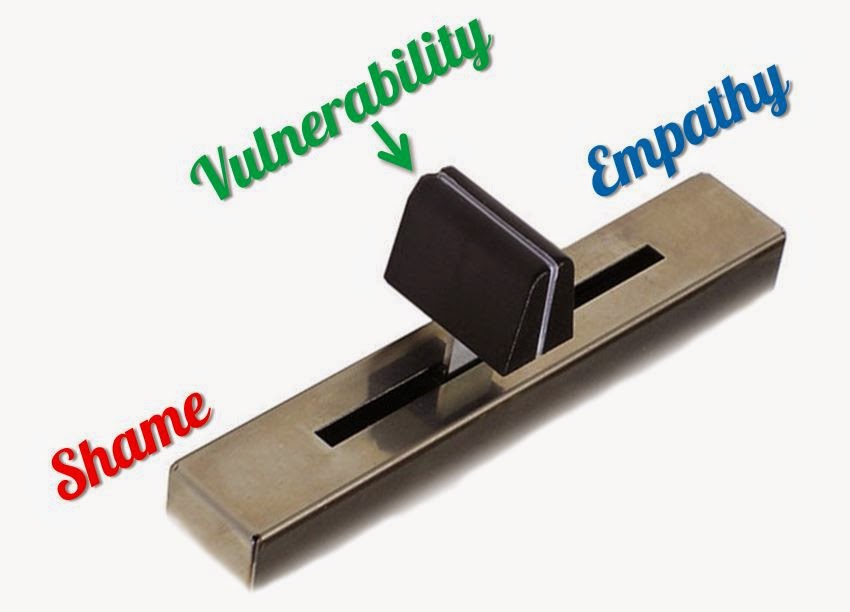
The opposite of shame is empathy.  On a continuum, with shame on one end and empathy on the other, the control knob that moves us from one side to the other is vulnerability.  The less vulnerable I am, the more I am on the shame side.  The more vulnerable I am, the closer I get to the empathy side.  

Numbing My Emotions
It’s hard to go through life feeling that I’m “bad” and that I’m a disappointment to God and others.  So I learned how to numb those emotions.  The problem with this is that we can’t selectively numb emotions.  I can’t say, “I think I’ll numb shame, anger, insecurity and regret, but I’d like to still feel happiness, excitement, gratitude and peace.”  When I choose to suppress any emotions, I suppress them all.  Consequently, I also suppressed my ability to feel the Spirit.  And that’s a lonely and dangerous place to be.  

Taken to an extreme, this is where addictions show up.  We anesthetize to make us feel good.  The world uses alcohol, drugs, sex, pornography, gambling, etc.  I could never go there, because those were obviously against the rules.  But there are other addictions that are easier to justify:  staying busy, keeping control, compulsive shopping, food, extreme exercise, caretaking, being organized, and social networking.  These are harder to see as potentially destructive.  

So as I’ve begun to allow myself to feel again, I’m better able to recognize and label my emotions.  The “negative” ones are less threatening to me.  And I’m learning better ways to express them.  

Black-and-White Thinking
Part of my OCD is the tendency toward all-or-nothing thinking.  I have to be perfect or I’m a failure.  It’s like there’s no middle ground or gray area.  I use words like “always” and “never,”  “ultra” and “uber.”  Life is either wonderful or horrible.  If I’m not excellent at something, then I’m simply mediocre, which is as bad as being awful.  

This thinking is also tied into comparison and competition.  I’m always aware of how others are doing and how my performance compares with theirs.  If I’m only getting the 2nd highest grade in a class, it’s devastating.

Since I’ve recognized this tendency in myself, I’m better able to be content with lowered expectations.  When I hear my mind thinking in black and white, I know how to talk back in appropriate ways.  One scripture that helps me here is that “it is not requisite that a man should run faster than he has strength.”  (Mosiah 4:27)

To be continued . . . with Part 4.

Confessions of a Recovering Perfectionist – Part 2

For a large part of my life, especially the past seven years, I’ve felt “stuck”—like something was impeding my progress.  I felt like there was something significant that I wasn’t experiencing, but was supposed to be.  I couldn’t put my finger on it.  I’d hear people talk about certain concepts that should have been so simple to understand, but they were just not penetrating my head nor my heart.  

When I look back now, I can see that I truly was progressing, just so incrementally that I didn’t recognize what was happening.  The Lord was laying a foundation for what He was going to do with me.  There are numerous remarkable experiences I’ve had, which at the time didn’t seem that big, but it really was a “line upon line” process where one bit of understanding led to the next, and so on.  

Things really started to change in 2011, when a conference talk by Pres. Eyring made a particular impression on me.  I acted on those impressions, and they led to a series of good decisions that guided me in the direction I needed to go.  The most important changes I needed to make were regarding the condition of my heart.  

In the fall of 2014, I was attending a workshop with my wife.  The speaker shared some ideas that resonated with me.  I spoke with him afterward and felt that he could help me break through whatever barriers were keeping me stuck.  It turns out that he was a therapist, and he agreed to meet with me.  

It didn’t take long for him to recognize in me the symptoms of shame.  

Once I knew what I was fighting, that recognition helped me identify how shame really is the birthplace of perfectionism.  

I also recognized that my feelings of shame were directly related with my inability to feel God’s love for me and to believe that I am worthy of love and grace.

Following are some of the concepts and “aha” moments that have helped me in this journey.


God Loves Me

In the past couple of months, I’ve had several experiences when I’ve truly felt God’s love for me.  It’s not just an intellectual assumption or something I learned in Sunday School and then repeated.  Other people may have these frequently, and so they are perhaps not that unique to them, but for me, they are a different and very important part of my recovery.  Here are a few that were life-changing and really have stuck with me.  

I was reading the January 2015 Ensign magazine.  Elder LeGrand R. Curtis’ article entitled “He Ran, and Fell on His Neck, and Kissed Him” recounts the parable of the prodigal son.  I’ve read and heard this parable many times, and I always thought I understood the point of it.  But this time (I’m sure it was because of the new heart God is giving me), I finally saw the father in the story as my Father, and the son as me.  The son “came to himself” and determines to go back home.  The father isn’t standing there on the porch with his hands on his hips with a “well, it’s about time you came to your senses” look.  Rather, while the son is “yet a great way off,” the father sees him, has compassion on him, runs to him, falls on his neck, and kisses him.  As I read this I was overwhelmed with the Father’s love for me!  It was very real and it filled my heart, something I’m not used to, but am becoming increasingly grateful for.

I found an incredible song.  The first time I heard it, I wept as I realized that this song, like no other I’ve found, expresses what has happened in me over the past few months, since:

  • I followed a prompting and started seeing my therapist
  • I was directed to the work of Brené Brown
  • I’ve found opportunities for expression and belonging
  • I’ve stopped numbing my emotions
  • I’ve started to reclaim my life from shame and OCD
  • I’ve felt more my Father’s love for me than ever before!

Sorry to sound so dramatic, but this is truly powerful for me!  It’s what my heart has been craving all my life!  God is giving me so much hope for the future!  The song is The Glorious Unfolding by Steven Curtis Chapman.

I was studying a talk by Wendy Ulrich entitled Trusting in the Lord.  (She is the author of Weakness Is Not Sin, which has been a landmark read for me.)  As part of the talk, she invites her audience to participate in some guided imagery.  I participated and received a profound witness that God does, indeed, love me!  

I’m a member of my stake High Council, and we meet every other Sunday at 6:00am in the morning.  As part of those meetings, we often hear reports from missionaries who have just returned from their missions.   On one morning, all three returning missionaries shared, in their own individual ways, their testimonies of how we are “on God’s radar” and that he cares so much for even the weakest of His children.  The Spirit was strong and confirmed the truth of their words.  Tears rolled down my face, which is not something I let happen very often in public—I would typically hide it or suppress the feelings that were causing me to cry.  But this time I didn’t.  Why try and stop the very emotions I have prayed so much to be able to feel?  


Some Myths About Perfectionism

The following points are taken right from Brené Brown’s The Gifts of Imperfection, which is a must-read for anyone really struggling with this issue.

  • Perfectionism is not the same thing as striving to be your best. Perfectionism is not about healthy achievement and growth. Perfectionism is the belief that if we live perfect, look perfect, and act perfect, we can minimize or avoid the pain of blame, judgment, and shame. It’s a shield. Perfectionism is a twenty-ton shield that we lug around thinking it will protect us when, in fact, it’s the thing that’s really preventing us from taking flight.
  • Perfectionism is not self-improvement. Perfectionism is, at its core, about trying to earn approval and acceptance. Most perfectionists were raised being praised for achievement and performance (grades, manners, rule-following, people-pleasing, appearance, sports). Somewhere along the way, we adopt this dangerous and debilitating belief system: I am what I accomplish and how well I accomplish it. Please. Perform. Perfect. Healthy striving is self­-focusedHow can I improve?  Perfectionism is other-focusedWhat will they think?

Understanding the difference between healthy striving and perfectionism is critical to laying down the shield and picking up your life. Research shows that perfectionism hampers success.  In fact, it’s often the path to depression, anxiety, addiction, and life-paralysis.  Life-­paralysis refers to all of the opportunities we miss because we’re too afraid to put anything out in the world that could be imperfect. It’s also all of the dreams that we don’t follow because of our deep fear of failing, making mistakes, and disappointing others. It’s terrifying to risk when you’re a perfectionist; your self-worth is on the line.

  • Perfectionism is a self-destructive and addictive belief system that fuels this primary thought: If I look perfect, live perfectly, and do everything perfectly, I can avoid or minimize the painful feelings of shame, judgment, and blame.
  • Perfectionism is self-destructive simply because there is no such thing as perfect. Perfection is an unattainable goal. Additionally, perfectionism is more about perceptionwe want to be perceived as perfect. Again, this is unattainablethere is no way to control per­ception, regardless of how much time and energy we spend trying.
  • Perfectionism is addictive because when we invariably do experience shame, judgment, and blame, we often believe it’s because we weren’t perfect enough. So rather than questioning the faulty logic of perfectionism, we become even more entrenched in our quest to live, look, and do everything just right.
  • Feeling shamed, judged, and blamed (and the fear of these feelings) are realities of the human experience. Perfectionism actually increases the odds that we’ll experience these painful emotions and often leads to self-blame: It’s my fault. I’m feeling this way because “I’m not good enough.”

To be continued . . . with Part 3.

Confessions of a Recovering Perfectionist – Part 1

When I was a kid, I somehow got the idea that I needed to be perfect to make it to heaven.  (“Be ye therefore perfect . . .” Matt 5:48.)  So my whole life I worked at it.  I had what is called a perfectionist OCD.  I felt that in order for me to be worthy, I needed to keep all the rules and commandments.  My self-worth was tied to my accomplishments and achievements.  If I got good grades, won the spelling bee, placed in the science fair, received my Boy Scout awards, dove off the high-dive, made the select choir, etc. — then I was able to feel good about myself.  I was very judgmental of myself and others.

Here’s a definition of perfectionism:  A disposition to regard anything short of perfection as unacceptable.

I remember a Primary teacher teaching us about the importance of keeping the commandments.  In my perception, she painted a picture of a God who was constantly watching me from above with a clipboard where He marked a black mark every time I did something wrong.  The hymn only seemed to substantiate that:  “Angels above us are silent notes taking, of every action, then do what is right.”  (If I could look back now at a video of that Primary class, I believe that what my teacher said was probably very appropriate and true.  But we “color” the things we experience and put our own spin on them based on our beliefs and perceptions.  So I probably heard what I wanted to hear and built it out of proportion.)

 Of course, it’s impossible to be perfect in this life.  But that didn’t stop me from trying.  I had to-do lists, routines, self affirmations, etc.  I figured that if I could just be extremely organized, then I could manage to get closer to perfection.


I had a hard time feeling that I was worthy, unless I was working really hard at it.  Even though I sang “I feel my Savior’s love” and “yes, I know Heavenly Father loves me,” it was mostly words I sang, without the understanding of what they meant. 

I didn’t feel that God or others could really love me if I made mistakes.  I felt that I was flawed, defective, and “broken” as a human being most of the time.

There were times when I felt better, like on my mission, or in the Young Ambassadors, or when I was a bishop.  But most other times, I have struggled to really feel the Lord’s love.

I thought that if I were ever going to make it to heaven, I’d have to earn my way there by being “good.”  The scriptures teach that we are all sinners and that no unclean thing can enter into the kingdom of heaven.  So whenever I did something “bad,” it took a heavy toll on my self-worth, and I began to doubt that I could actually make it to heaven.

I also was overly concerned of what others thought about me and how I appeared to them.  So I became proficient at putting on a false front.  I had to look like I had it all together, even though I didn’t.  Often, I was barely surviving, because of the stress caused by maintaining that facade and keeping up with all of the expectations. 

I learned about repentance and that it was possible because of the Savior’s Atonement, but it seemed to have a negative connotation.  Because of the sacrifice and suffering of Christ, I was able to repent, but if I had to keep sinning and repenting, sinning and repenting my whole life, I’d never be able to cross it off my list as something I had completed or accomplished.  Also, my approach to repentance was making sure I followed the Five Steps to Repentance (recognize, sorrow, confess, ask forgiveness, forsake) so I could cross them off one at a time.  It was less about involving the Savior in the process. 

Now that I’m older and am getting a better handle on my OCD, I realize that I have inherent worth as God’s son.  He does want me to progress and become more like Him, but his love isn’t based on my obedience or my accomplishments.  His love is (and always has been) unconditional.  There’s nothing I could do to make Him stop loving me.  I’ve always “known” this intellectually, but I didn’t always feel it in my heart.

Now I know that my worth to God doesn’t fluctuate.  I had previously felt that my self-worth gauge went up and down like a little meter.  If I made a mistake, the marker on the meter went down.  Then I had to do something good to make the marker go up, like volunteer for a service project, or read an extra chapter in the scriptures, or do some family history, or be a better friend, or clean the house, or fast longer than 24 hours, or “something” to make up for it. 

I now realize that the Savior’s atonement covers not only my sins, but also my inadequacies, my disappointments, my weaknesses, my infirmities, my carelessness, and my lack of talent, and that it compensates for all of the trials, the unfairness, and bitterness of mortal life. 

I wish it hadn’t taken me 50+ years to figure this out.  I don’t blame anyone for how I felt.  It was my own faulty perceptions and ways of thinking.

Apparently, I’m not the only one who has struggled with perfectionism.  I can show you a lot of research and studies that show that a high number of Latter-day Saints and people from other religious backgrounds have a similar mentality.  And the church leaders are also aware of it.  You may have noticed recently that more general conference talks have addressed this issue, especially Elder Scott, Elder Holland, and President Uchtdorf.  (Or maybe it just seems that way to me because that’s what I hear them saying.)  Elder Cecil O. Samuelson, of the Seventy, and former president of BYU, spoke to the missionaries at the MTC in Provo about it.  It seems that one of the main causes of missionaries returning early from their missions is this issue.

Here’s the real confession:  Since I had this perfectionist OCD, I also mistakenly expected perfection from everyone else, and was judgmental when they erred.  I apologize for that.

I want to testify of the power of the Savior to deliver us from our ailments.  This includes incorrect ways of thinking.  Through His Atonement, we can receive healing from the damage we experience.

Resources for Understanding and Overcoming Perfectionism