
There Is a Space
One tendency I have that gives me grief is when I act before I think—or (more accurately) feel. If I’m really angry, nine times out of ten I will say or do something I will later regret. If I make a mistake, I’ll likely go right into shame, which is an unproductive place to stay.
Psychologist and Holocaust survivor, Dr. Viktor E. Frankl, who wrote, Man’s Search for Meaning, says:
“Between stimulus and response there is a space. In that space is our power to choose our response. In our response lies our growth and our freedom.”
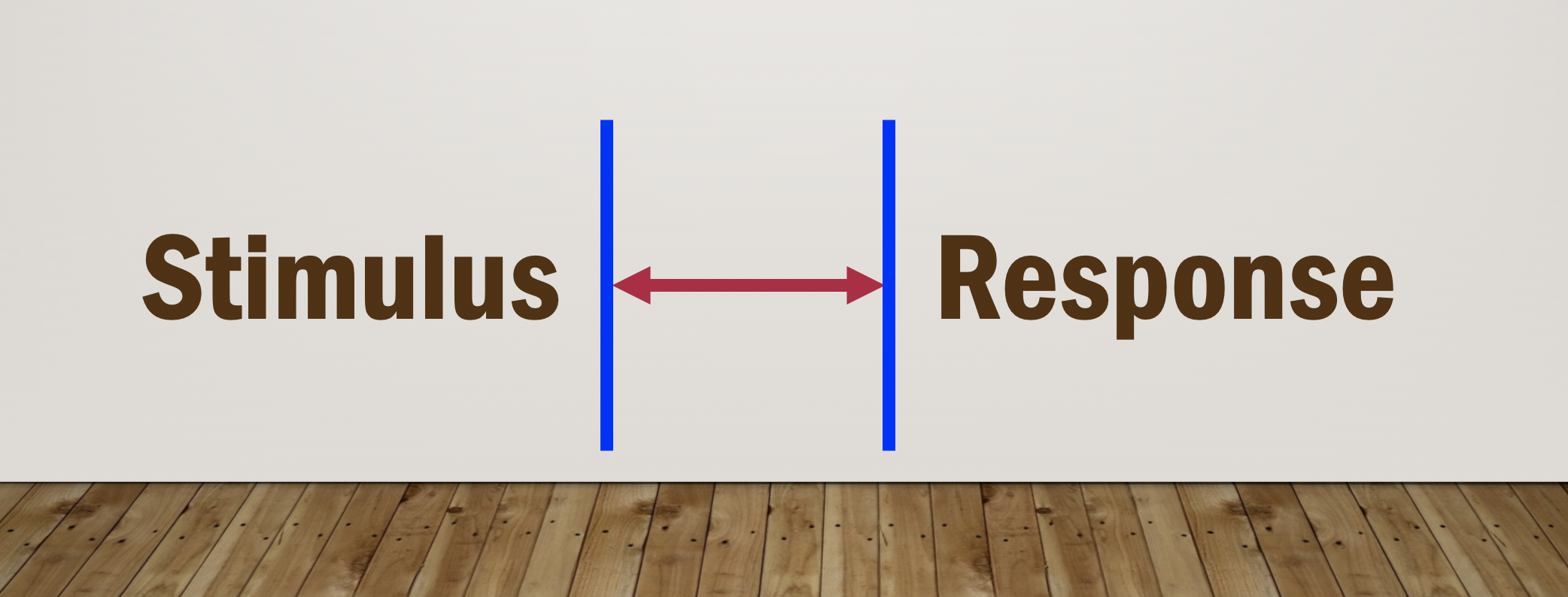
This space may be just a fraction of a second, or longer. It may be the time it takes me to count to ten, take a couple of clearing breaths, or ask myself what would be the better way to behave. If I can push the pause button and widen the gap, I have more options. I have more freedom to choose. (See 2 Nephi 2:27.)
In his book, Permission to Feel, Marc Brackett, Ph.D. calls this the “Meta-Moment.”
In simplest terms, it’s a pause. The meta-moment is you hitting the brakes and stepping out of time. We call it meta because it’s a moment about a moment.
It’s where we stop the action and say, “I need to take a pause and a deep breath right now so I don’t blow my top or break down sobbing or otherwise react in a way I will probably regret.”
Instinctively, we sense that this will help, and biology proves us right. Pausing and taking a deep breath activates the parasympathetic nervous system, which reduces the release of cortisol, the stress hormone, and automatically lowers our emotional temperature.
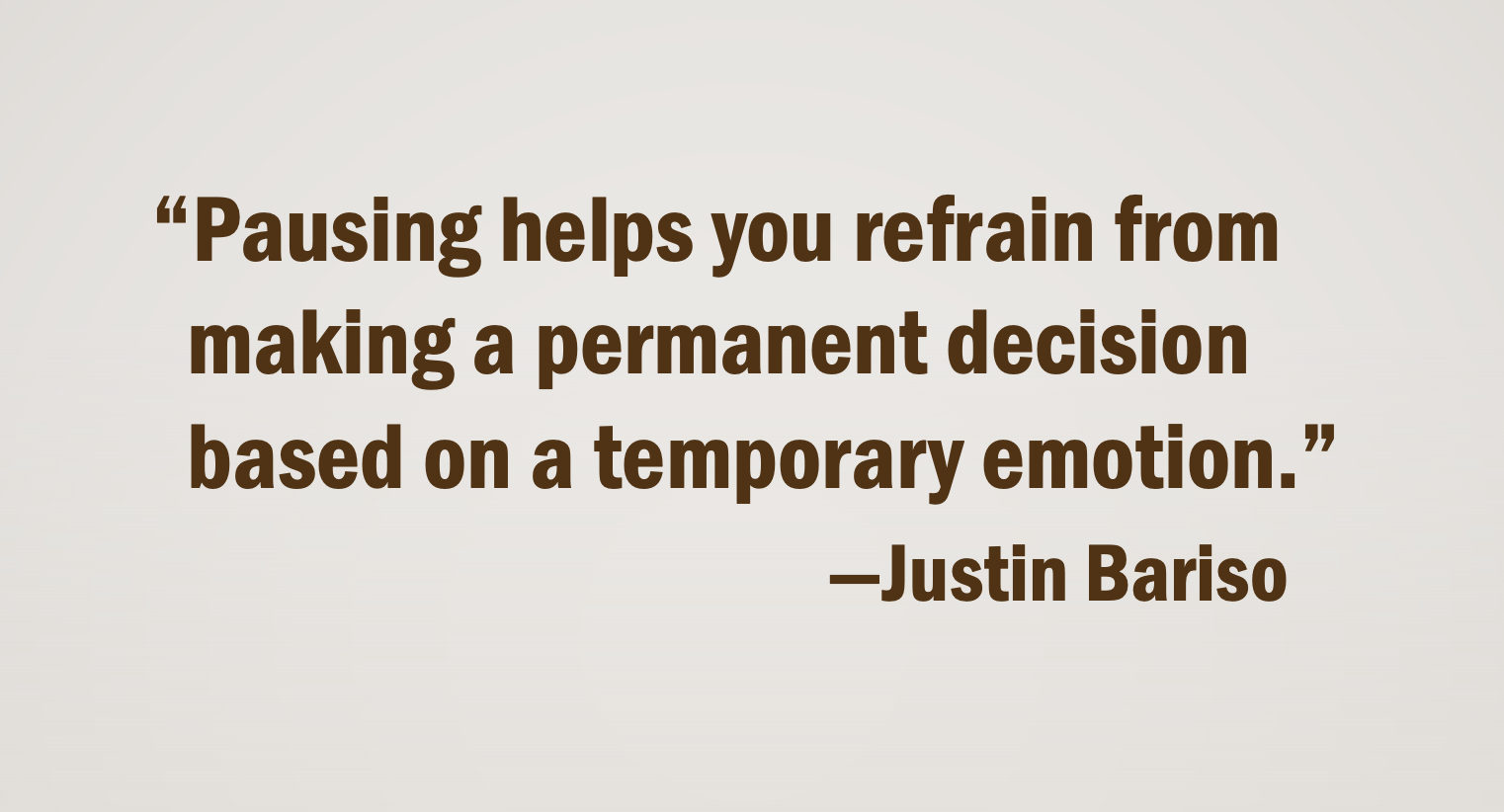
It also gives us the chance to quickly ask a few questions that might be useful, such as: “What would my best self do right now?” That ideal, hypothetical person is comprised of attributes we would use to describe our best selves from our own perspective and from the perspective others—how we’d like to be experienced, seen, or talked about. For some people it’s a set of adjectives like compassionate, empathic, or conscientious; for others it can be an image or an object. A good friend who is a manager at Facebook has a photo on her desk that reminds her to be her best self.
Visualizing our best-self redirects our attention away from the “trigger.” This helps us to choose a helpful emotion regulation strategy, like positive self-talk or reappraisal, and then respond accordingly.
I believe that the space between stimulus and response is where the Atonement of Christ can operate. When I’m in that space, if I will take a second and ask for His help, the enabling power of His grace can influence me to be better than what I could be in-and-of my own strength. It’s the difference between reacting and responding.
To be continued . . . with Part 69


 Imagine yourself in a room, a very dark room with only a small amount of light visible—just enough to make out the outlines of some furniture and the walls around you. You can tell the room is in disarray. There is a couch haphazardly shoved into a corner with the cushions spread everywhere on the floor. Two chairs are overturned and a table with some legs missing is lying upside down in the middle of the room. A floor lamp with its shade missing is propped diagonally against the wall.
  Now, you wonder what more you can do, but then a thought strikes you. I could get a new table, those other walls could use some beautiful pictures, perhaps I could add a vase with flowers and perhaps some new chairs. And on and on this could go. Every time you report, you are given more light and told to clean again. Pretty soon you’re knocking out walls, and adding wood floors, and upgrading the rug and furniture. You are filled with a vision of what the room could someday be and you find fulfillment and purpose in adding to and improving it.
  The inner critic—that nagging inner voice—judges, criticizes, and demeans me. Over time, it damages my self worth and takes a toll on my soul. This destructive chatter is fueled by shame and faulty core beliefs—ultimately by the enemy, the father of lies.
  Again from
  When he looked at people, it was like He could see everything about them. Even though his atonement was in the future, He seemed to know all about them—their struggles and challenges. And he was full of mercy and compassion.
  I watched the first season free online. I was so impressed that I made a donation to the cause. I also purchased the DVD set of Season 1, which helps them fund Season 2. I noticed at Deseret Book that the DVDs were in the #1 Bestseller spot on the shelf.
  The religious scholars—who conducted the study at BYU—found that religious young adults experience better or poorer mental health as it connects to their belief in grace or in legalism. They surveyed 566 young adults at BYU (most of whom are members of the Church of Jesus Christ of Latter-day Saints) and found that when these young adults believe more in grace and less in legalism, they experience less anxiety, depression, shame, religious guilt, and perfectionism. They also found the opposite: When young adults have a more legalistic view of God, they experience poorer mental health “because it interrupts [their] ability to experience grace.”
  No matter how hard we work, no matter how much we obey, no matter how many good things we do in this life, it would not be enough were it not for Jesus Christ and His loving grace. On our own we cannot earn the kingdom of God, no matter what we do. Unfortunately, there are some within the Church who have become so preoccupied with performing good works that they forget that those works—as good as they may be—are hollow unless they are accompanied by a complete dependence on Christ.
 Unfairness is all around us and it is troubling. If we’re not careful, the appearance of unfairness may cause us to reject the favorable along with the unfavorable. Or to use an idiomatic expression, “to throw the baby out with the bathwater.” Perceived unfairness deals us a major body blow.
  The base isolator for unfairness is to develop faith in Jesus Christ and His atonement and understa
 The Lord doesn’t want us to let our hearts be troubled or afraid. For a perfectionist, that’s easier said than done. Fear is at the core of our struggle. Fear of not being worthy of love or acceptance.
  I promise each of us can and will be blessed with direction, protection, and lasting joy as we learn to not take counsel from our fears. As we exercise faith in Christ and trust in His promises, we can walk into the dark with the absolute assurance that our pathway will be illuminated at least far enough to take the next step and then the next step and the next step.
 To make room for God to fill the vessel of our soul, we have to begin moving out some of the unnecessary clutter that continually accumulates there like the junk drawer in your kitchen. Everybody has a junk drawer, that black hole for car keys, pens, paper clips, gum, all the small flotsam and jetsam that accumulates over time. Our souls accumulate stuff, too, pulling it in like a magnet. And so Augustine said we must empty ourselves of all that fills us, so that we may be filled with what we are empty of. Over time I’ve found no better practice to help clear out my cluttered soul than the practice of benevolent detachment. The ability to let it go, walk away—not so much physically but emotionally,
  Jesus invites us into a way of living where we are genuinely comfortable turning things over to him: Are you tired? Worn out? Burned out on religion? Come to me. Get away with me and you’ll recover your life. I’ll show you how to take a real rest. Walk with me and work with me—watch how I do it. Learn the unforced rhythms of grace. I won’t lay anything heavy or ill-fitting on you. Keep company with me and you’ll learn to live freely and lightly. (Matthew 11:28–30 The Message) [Art by Yongsung Kim]
