Confessions of a Recovering Perfectionist – Part 130

I turned 70 this month. I won’t pretend that number didn’t give me pause. Birthdays like this tend to invite thoughts of years lived, mistakes made, blessings received, and questions still unanswered.

One thing has become clearer to me. If I want these later years to be peaceful and meaningful, I have to be careful not to turn my old perfectionism inward and let it rob me of joy. I don’t want to spend my time sitting in a rocking chair on the front porch, watching cars drive up and down the road, and yelling at the neighbor kids to stay off the lawn.  

For many of us in the Church, perfectionism doesn’t always look harsh or self-centered. Sometimes it comes out more subtly. It sounds like: I should be stronger than this by now. I should have more faith. I shouldn’t still be struggling with my body, my energy, or my emotions.

We know the scripture about becoming “perfect in Christ,” but somewhere along the way, some of us learned to interpret that as being hard on ourselves until we finally get it right.

Aging has a way of revealing how unkind that approach really is. Our bodies slow down. Energy comes and goes. Old regrets sometimes resurface. And if we’re not careful, we start treating these natural parts of aging as personal failures rather than normal parts of mortality.

One of the most freeing realizations I’ve had is this: aging is not a performance review. It’s not a test to see whether we exercised enough, served enough, or overcame everything we thought we should have overcome by now. Mortality doesn’t work that way. The gospel teaches us that growth is lifelong. And also, that weakness is not evidence that I’m a disappointment to God. “I give unto men weakness,” the Lord says, not as punishment, but as an invitation to humility and grace.

When we’re younger, much of life is about building careers, families, testimonies, and callings. Later life invites a different kind of discipleship. Less proving. More receiving. Receiving help. Receiving rest. Receiving the fact that slowing down doesn’t mean we’re sliding backward spiritually. I’ve noticed that people who seem to age with the most peace are not those who cling tightly to who they used to be, but those who allow themselves to become who they are now, without shame.

One of the quiet tasks of aging is learning to put down the internal checklist. The one that keeps track of 1) what I should still be able to do, 2) what others my age seem to be doing better, and 3) what I wish I had done differently.

For my birthday, my wife gave me a mug. On the outside, it says “Man of wisdom.” I hope that’s who I’m becoming. 

As I step into this new decade, my goal is not to age flawlessly or even impressively. My goal is to age faithfully. To trust that the Lord is far more interested in my heart than in my productivity.

If perfectionism once pushed me forward, I no longer want it driving the rest of the journey. There is a quieter strength available now, one rooted in humility, compassion, and trust in Christ.

Confessions of a Recovering Perfectionist – Part 129

Last month, Elder Karl D. Hirst, General Authority Seventy, spoke at a BYU-Idaho Devotional. His talk was about repentance, which, for me, is linked to perfectionism. I’ve written about that connection in previous blog posts. 

For most of my life, I’ve had a pretty specific relationship with repentance. In my mind, it was mostly about clearing guilt, coming clean, and trying to avoid sinning in the future. But listening to this talk, I had a surprising realization. Repentance isn’t just about cleansing. It’s about changing into a better version of myself, even when I haven’t “messed up.” 

One of the most powerful ideas I heard is that imperfection and weakness are not proof of failure; they’re proof that we’re capable of growth. They’re part of the plan, not a distraction from it. Perfectionism often convinces me that flaws disqualify me. The gospel teaches that flaws prepare me. They make space for Christ’s grace.

Repentance literally means a change of heart and mind, a shift toward God, toward goodness, and toward better thinking and living. Nothing about that definition says repentance is only about sin. It’s about change. That means I can repent when I’m emotionally dysregulated, when I want more patience or optimism, and when I want deeper faith. I don’t need to wait for a big mistake to invite Christ into my life. His enabling power is accessed the same way as His cleansing power, through turning to Him. 

One of the most reassuring truths I heard was this: “Being weak does not mean we are Satan’s, it means we are capable of growth. Our weakness is God’s opportunity. Perfection will take care of itself if we will seek the Lord’s power in our progress and our participation.”

Perfectionism says, “You should have already arrived.” God says, “You are on your way.” Those are very different views.

The most hopeful insight I took away is this: Repenting and rejoicing are much closer than I realized. When I repent and turn toward Christ, I am also turning toward joy. In other words, repentance isn’t a depressing reminder of how far I fall short. It’s a pathway to the happiness and wholeness He wants to give me.

That’s a beautiful way to think about progress. Baby steps still count. Small improvements matter. Even patience in the process is part of the journey. Growth happens gradually, but consistently. He wants me to turn to Him, to use repentance as a tool for transformation, not just correction.

This is possible not because I’m capable enough or disciplined enough, but because the Savior’s grace is enough. That’s the kind of hope I want to carry forward. Not just the hope of being forgiven, but the hope of becoming something new.

Confessions of a Recovering Perfectionist – Part 127

For October, I usually promote a General Conference talk that speaks to the perfectionist part of me. This time, I’ve chosen Elder Kearon’s Jesus Christ and Your New Beginning. Here are some of my favorite parts:

I love the thought of new beginnings, unfettered by past mistakes and failures. I love the message of Lamentations 3:22-23 – “It is of the Lord’s mercies that we are not consumed, because his compassions fail not. They are new every morning: great is thy faithfulness.”

Take three minutes and listen to this song by Micah Tyler. 

Confessions of a Recovering Perfectionist – Part 123

When I read this post by Bethany Faden on Facebook, I could tell immediately that she was onto something. Rather than link to the post, I’m copying it here in its entirety and giving her full credit for it. 

Confessions of a Recovering Perfectionist – Part 121

After General Conference, for my monthly blog post, I usually choose a talk that deals with some of my perfectionistic tendencies. This time, the obvious choice is Sister Tamara W. Runia, First Counselor in the Young Women General Presidency. Here are some of my favorite quotes from her talk: 

This is one of the concepts that has helped me to become more shame resilient. I distinguish between my infinite worth and my behavior. Although my behavior may be maladaptive at times, my worth in the sight of God never fluctuates. 

You can read the full talk here

Confessions of a Recovering Perfectionist – Part 120

This month, I attended two events designed to help me develop my skills in facilitating psychodrama. 

The first was a weekend retreat sponsored by The Crucible Project. Here’s some more information about the organization as taken from their website:

Focus:
The Crucible Project aims to create a world where people live with integrity, grace, and courage, fulfilling their God-given purpose. 

Method:
They achieve this through transformational retreats, groups, and coaching, fostering communities where people live authentically and with integrity. 

Retreats:
These retreats are designed to challenge individuals to take a hard look at their lives, wrestle with God, and discover new truths about themselves, finding freedom to break away from self-sabotaging beliefs. 

Intense Experience:
The Crucible Weekend is an intense experience that can be emotionally, spiritually, and physically challenging. 

Radical Honesty and Grace:
The retreats emphasize radical honesty and grace, creating a space for individuals to wrestle with God and discover new truths about themselves. 

Community:
The Crucible Project fosters a community of men and women who have gone through the retreats, providing support and encouragement. 

Locations:
The Crucible Project has retreats in the United States, International locations, and Second-level Weekends. 

Vision:
Their vision is a world of men and women who live with integrity, grace, and courage. 

Mission:
Their mission is to ignite personal change in men and women through experiencing Jesus, and taking a journey of radical honesty and self-reflection.  

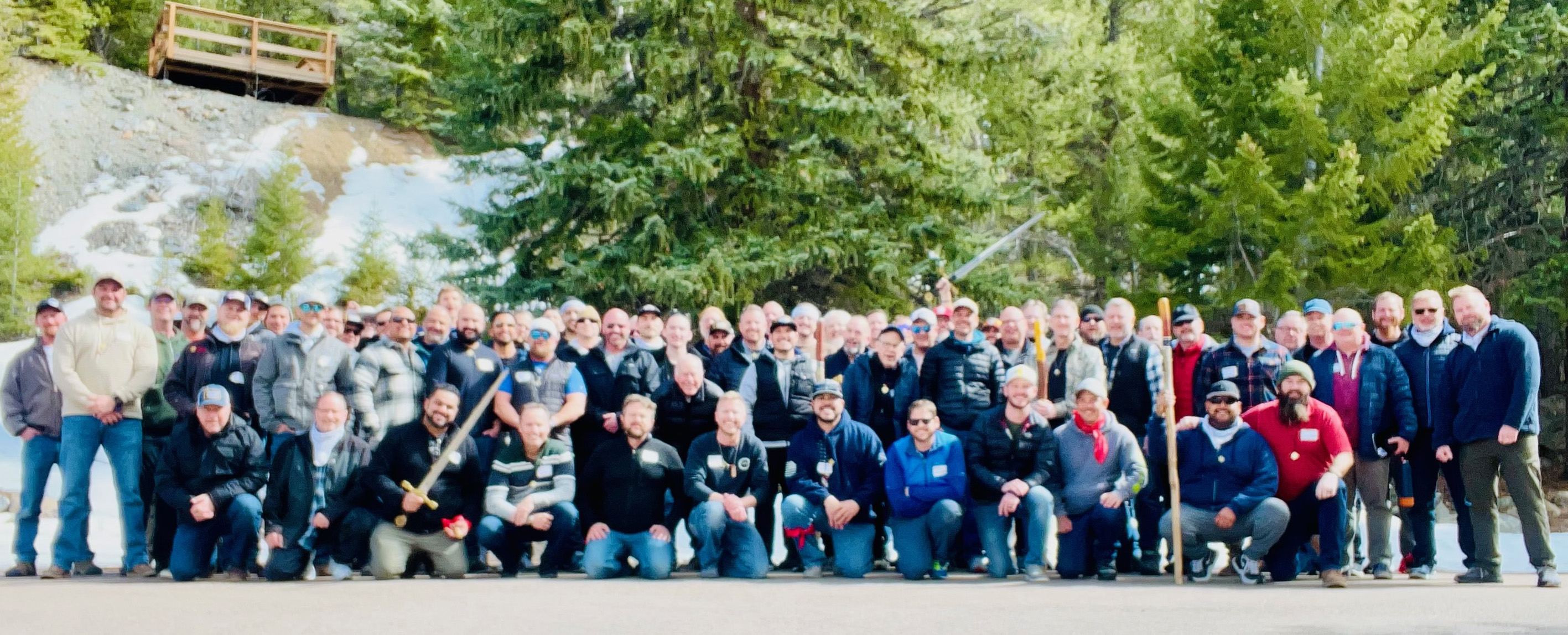
The retreat I attended was held in Empire, CO, about an hour west of Denver, at the Easter Seals Rocky Mountain Village facility. Most of the meetings were held in a lodge, and we stayed in cabins with other men. There were 37 participants and about that same number of staff members. (In the photo, I’m kneeling in front, second from the left.)

The second event I attended was a one-day Guts Work Facilitation Training held in Taylorsville, UT. It was held at the home of a man who was willing to host it free of charge. Eleven of us were in attendance, men who had previously participated in the Mankind Project NWTA weekend. Three were staff members, and the other eight of us were attendees. 

I’ve had a lot of talk therapy over the years with various counselors, which has been great, and I’ve needed it. However, this approach was different in that it was more experiential, somatic, and physical. It aligns well with a book I recently studied called “The Body Keeps the Score” by Bessel van der Kolk. The central premise of the book is that trauma profoundly impacts the brain and body, leading to physical and emotional dysregulation, and that healing trauma requires understanding and addressing these physiological and neurological changes.

One of the main processes used to heal these wounds is psychodrama. Psychodrama focuses on a person’s real-life experiences and internal conflicts, allowing individuals to explore and express their emotions and experiences through dramatic action. While it can be used in individual therapy, psychodrama is often conducted in a group setting, where participants can act out scenes from their lives under the guidance of a trained facilitator. Put together, then, a psycho-drama is quite literally a “drama of the mind and soul.” 

In each psychodrama process, I was able to re-enact a painful experience from my past. The result of the process is that I’m able to receive closure and resolution. Technically I don’t actually change what happened in the past, but I’m able to change how I feel about what happened. This results in greater peace and freedom. 

Some of my perfectionist tendencies are the result of experiences I had as a kid, where I felt like I needed to be perfect in order to be acceptable. Of course, perfection in this life is impossible, so that created a lot of internal chaos. Working through the scenarios as an adult showed me that those expectations were unrealistic. I can approach myself with kindness and curiosity. I’m better able to give myself grace. 

Confessions of a Recovering Perfectionist – Part 119

I stumbled across a quote by C.S. Lewis that addresses perfection and how the Lord intends to perfect us. This is great!

C.S. Lewis, Mere Christianity (1952; Harper Collins: 2001)

The Lord’s work and glory is to exalt me. And He knows how to do his work.

Confessions of a Recovering Perfectionist – Part 117

As I look at setting New Year’s resolutions, which is my MO at this time of year, I typically like to choose a word or phrase as a theme for the coming year. I haven’t settled on this one for sure, but I’m leaning toward “be still.” 

I’m grateful that I’m retired and have a little more time to pull back from the daily grind and find peace and calm. It’s nice to not feel the expectation of constantly needing to “get it right” but rather, breathe in the stillness. 

Confessions of a Recovering Perfectionist – Part 115

When I watch General Conference, I listen for specific guidance for those of us who struggle to feel God’s love. Elder Hirst’s talk stood out to me. Let me share some of my favorite parts. 

Confessions of a Recovering Perfectionist – Part 109

During General Conference, I listen to see who addresses anything pertaining to perfectionism. This time, I chose Elder Kearon’s talk because of the hope it gives for removing barriers to returning to God. It also shows how much God wants us back with Him. I pulled several paragraphs straight from his address: 

How could he be more direct? How could I dispute the Lord’s goodness and love? And Elder Kearon’s fun British accent adds to the sweetness of the truths he shares.