Confessions of a Recovering Perfectionist – Part 28

I Missed a Month


Since I started this blog, I’ve been pretty good about posting each month—actually, I’ve been perfect at it. But I missed posting one in June.  So here we are at the end of July and I’m posting again.  Perfectionists often are somewhat bound by routine and compliance.  My perfectionistic tendency would cause me to feel that it’s not OK to miss a month. Besides the fact that June was ludicrous, I decided to let it be OK—as part of my recovery—to miss a month. July has been more cooperative.  


Loving Myself


“And if I asked you to name all the things that you love, how long would it take for you to name yourself?”


I recently saw this question on social media. It hit home. For a perfectionist, it’s difficult to love myself unless I’m performing up to expectations.  


Here’s a conundrum:  


The Savior taught that “whosoever will save his life shall lose it: and whosoever will lose his life for my sake shall find it” (Matt. 16:25).


I’ve often heard that you can’t give something to others that you don’t have yourself.


Elder Holland taught: “You have to have something in the tank before you can give it to others.”  


The scriptures teach that “the inward vessel shall be cleansed first” (Alma 60:23) and I’m instructed to “first cast out the beam out of thine own eye; and then shalt thou see clearly to cast out the mote out of thy brother’s eye” (Matt. 7:5).


So if I’m struggling to love and understand myself, can I really love and understand others?  


Actually, I don’t think it’s that black and white. I believe there have been times when I’ve been able to give beyond what I own. If my intent is to do it “for my sake”—meaning the Savior’s sake, then he will augment my ability to give. And I’ll be enabled to accomplish more than I would with my own natural capabilities.  


As a perfectionist, I’ve also tended to be a pleaser. But with that mentality, the most important person for me to:
    • connect with
    • show compassion for
    • respect
    • be kind to
    • care about
    • be gentle with
    • accept
    • etc.
—is myself.  When I can do that adequately, then it’s much easier to do for others—with the right motives.  
To be continued . . . with Part 29

Confessions of a Recovering Perfectionist – Part 27

Connection
In her book Daring Greatly, Brené Brown says:  “Connection is why we’re here; it is what gives purpose and meaning to our lives. The power that connection holds in our lives was confirmed when the main concern about connection emerged as the fear of disconnection; the fear that something we have done or failed to do, something about who we are or where we come from, has made us unlovable and unworthy of connection.”
We need to feel like we belong, like we are loved and accepted.  When we don’t, it’s painful.  Naomi Eisenberger, professor of Social Psychology and Director of the Social and Affective Neuroscience Laboratory at UCLA teaches:  The experience of social pain, while temporarily distressing and hurtful, is an evolutionary adaptation that promotes social bonding and, ultimately, survival. “That hurt my feelings.” “My heart was broken.” If you listen closely to the ways in which people describe their experiences of social rejection, you will notice an interesting pattern: we use words representing physical pain to describe these psychologically distressing events. In fact, in the English language we have few means of expressing rejection-related feelings other than with words typically reserved for physical pain. Moreover, using such words to describe experiences of social rejection or exclusion is common to many languages and not unique to English.
Scientific research shows that reaching out to others can help us cope with the trials of life more effectively.  
That’s why we have 12-step support groups, the Addiction Recovery Program.  The opposite of addiction is not sobriety, but human connection.  
Often, those who deal with addiction, perfectionism, shame, and many other struggles, tend to pull back, to withdraw, to isolate themselves.  But when they turn toward others and reach out, healing occurs at a faster rate.  
It takes effort to develop friendships and to ask others to be part of our support network.  But it’s worth the effort.  As human beings, we’re designed to connect with others.  No man is an island.  One of the purposes of a church is to provide opportunities for fellowship.  Pres. Hinckley often taught that we all need a friend.  According to God, it isn’t good to be alone.  We’re all part of one large eternal family.  

To be continued . . . with Part 28

Confessions of a Recovering Perfectionist – Part 26

Fear vs. Love


I recently finished the book “The Four Agreements” by don Miguel Ruiz.  I really enjoyed it and found that much of it aligned with other concepts I’ve learned over the past few years.  One of the ideas he teaches is that fear is the main cause of suffering.  And that emotions such as anger, envy, shame, guilt, hopelessness, and jealousy are secondary emotions based on fear.  


Ruiz refers to people who decide to embrace the four agreements and generate love and joy in their life as spiritual warriors. It is warfare because you are confronting the old fear-based beliefs in your brain. It may take a few weeks to break free from fear, the oppressiveness of the inner critic, and old emotional habits. Some battles may be lost along the way, but that is to be expected as you invite love and joy into your heart and your life.


The battle of the spiritual warrior is for personal freedom—freedom from fear, delusions, and the fear-based belief system that has controlled your mind. Essentially, it means to win the battle over the beliefs from the past. As you achieve personal freedom, you become free from the emotional suffering caused by your fears. This freedom allows you to live a life of gratitude, non judgment, and love for self and others.   


As I studied this book, I was reminded of phrases from Elder Uchtdorf’s recent Conference talk, Perfect Love Casteth Out Fear.  Here are four of my favorite paragraphs:


My message has two purposes today: The first is to urge us to contemplate and consider the extent to which we use fear to motivate others—including ourselves. The second is to suggest a better way.


It is true that fear can have a powerful influence over our actions and behavior. But that influence tends to be temporary and shallow. Fear rarely has the power to change our hearts, and it will never transform us into people who love what is right and who want to obey Heavenly Father.


People who are fearful may say and do the right things, but they do not feel the right things. They often feel helpless and resentful, even angry. Over time these feelings lead to mistrust, defiance, even rebellion.


My beloved friends, my dear brothers and sisters in Christ, if we ever find ourselves living in fear or anxiety, or if we ever find that our own words, attitudes, or actions are causing fear in others, I pray with all the strength of my soul that we may become liberated from this fear by the divinely appointed antidote to fear: the pure love of Christ, for “perfect love casteth out fear” (1 John 4:18).


Being a perfectionist, I’ve struggled with the expectation of having the “perfect” love that casteth out fear.  But I don’t believe this means my love has to be perfect.  Only the pure love of Christ is perfect.  And as I strive to become more like Him, He will perfect my efforts, which will bring the spiritual confidence to dispel fear and invite Love.  
To be continued . . . with Part 27

Confessions of a Recovering Perfectionist – Part 25

My whole life I’ve been a grammar-Nazi.  


Somehow, as a kid in elementary school, grammar rules and mechanics came easy to me.  I quickly caught on to concepts like subject/verb agreements, direct/indirect objects, and prepositional phrases.


I not only held myself to a high standard of using the English language, but I also had high expectations of others.  


Living most of my life in Southern Utah and Eastern Idaho, I’ve associated with a lot of down-home folk, who are unaware of many rules and expectations.  They mostly just speak and write as they’ve been brought up.  


One misuse that has driven me crazy is: “these dishes need washed,” “the lawn needs mowed,” “this floor needs vacuumed,” “the cat wants fed,” “that baby needs changed,” etc.  Technically, they are deleting the infinitive.  The correct phrasing would be either “these dished need to be washed” or “these dishes need washing.”  


Another one that grates on me is “we seen him at the reunion ” instead of “we saw him at the reunion;” or “we was just sittin’ down for lunch” instead of “we were just sitting down for lunch.’  The pronoun and verb need to be in agreement.


Much of social media is written.  In the past, when reading a blog or Facebook post, my perfectionistic self would focus and obsess on spotting errors:  your vs. you’re, their vs. there vs. they’re, loose vs. lose, should of vs. should’ve, etc.  I prided myself on being able to catch someone in an incorrect use, and then mentally (and sometime publicly) berated them for their lack.


This was all brought to my attention when I was listening again to a conference talk.  In a recent General Conference, one of the Brethren gave a talk about how stumbling blocks can complicate and confuse us in our growth toward becoming like the Lord.  


At one point he mispronounced “grievous.”  I immediately began a mental conversation about how an apostle should know better, and that someone should’ve caught it in the teleprompter rehearsal, and that people lose credibility when they mispronounce something before a large audience, etc., etc.  Meanwhile, because of my mental analysis I didn’t hear what he was teaching for a while after that.  I missed out because of my inability to overlook the mistake.  

Ironically, the very concept he was trying to make was about how a stumbling block can prevent someone from progressing.  It was not lost on me.  


I’m also aware that I typically can’t see my own typographical errors.  (You may have noticed some in my posts.)  So if I expect others to be nonjudgmental of my writing, I need to reciprocate.  


Although my OCD toward correct grammar has been significant throughout my life, in recent months/years, it has begun to diminish.  As I’m recovering, I’ve noticed that it doesn’t affect me as often or as strongly.  I’m able to more easily just let it go.  
To be continued . . . with Part 26

Confessions of a Recovering Perfectionist – Part 24

This is Part 24, which means I’ve been posting to this blog every month for two years.  Over the past few months, I’ve been noticing that I’m having fewer issues with perfectionism than I had in the past.  If this keeps up I may need to stop writing this blog, since the initial premise was to document what I’m learning about my perfectionism.


In other words, I’m progressing, getting healthier, in recovery, doing my work, trusting the process.  My therapist is also noticing my improvement.  If this keeps up, I may need to stop seeing him as often.  


So if I’m having fewer issues, why is that?  To what can I attribute my progress?  


Ultimately, I give the Lord the credit.  He led me to my therapist.  He brought healing resources into my life.  He is changing my heart and mind.  There are many factors contributing to my improved emotional health surrounding perfectionism, but I glorify God for the tender mercies.


From a therapeutic standpoint, I’d have to say that the most significant help has been an understanding of faculty core beliefs and how they have affected me for most of my life.  Faulty core beliefs usually develop at a young age and are sometimes unconscious.  So identifying them is an important part to overcoming them.  


Faulty: false
Core: about our souls
Belief: how we perceive and value


Typical faulty core beliefs are:
I’m not _______ enough.  (Insert the adjective — good, smart, thin, happy, rich, young, etc.)
I’m not loveable.
I’ll never get it right.
I’m not worthy.
I’m inadequate.
I’m bad.
I’m defective.


The interesting thing is: these are not just faulty thoughts, but faulty beliefs.  Intellectually, I get the fact that I’m smart, worthwhile, valuable, and good.  But beliefs are beyond just my thoughts; they are seated in my emotions.  So while I might have a cognitive understanding of my value, I have a hard time believing it.  It’s a head vs. heart problem.  


If it is my belief that I am flawed in some way, regardless of any proof I may have to the contrary, that belief becomes my truth and I will behave in a way that validates my perception of reality.


Faulty core beliefs are also closely tied to shame.  That’s why my therapist has worked with me on becoming shame-resilient while we have also been working on improving my core belief system.


As I’m doing my work, I’m less perfectionistic.  I have a healthier outlook for the future.


Actually, to think I won’t have issues with perfectionism in the future is idealistic.  It’s difficult to change something that has been so ingrained for so many years.  But the fact is, I’m experiencing less suffering than in the past.  I’m in a better place now than I’ve ever been.

To be continued . . . with Part 25

Confessions of a Recovering Perfectionist – Part 23

Pride and Perfectionism
Perfectionism is tied to self-worth.  If I can just do things perfectly then I can feel better about myself.  


Prophets have taught that we are a royal generation, for generations.  That we have been saved for these last days to come forth when our gifts and abilities are most needed.  


My patriarchal blessing says that I was one of the valiant in the premortal life. My wife’s says that she will marry a noble son of our father in Heaven.  


So with all of this evidence about my greatness, why have I still suffered from low self-worth?  You’d think it would be the opposite.  You’d think I would suffer from pride and a sense of my “specialness.”  Actually, I do.  President Ezra Taft Benson taught that “pride is the universal sin, the great vice.”  And we perfectionists definitely have our issues with pride.  Because I feel bad about myself, then I need to build myself up.  


Comparing and Competing
As a kid, it shows up in boasting and bragging about my accomplishments.  Comparing and competing become important ways for me to demonstrate that I measure up.  As an adult, it’s the same thing.   


For guys, all sorts of competitions are great ways to show how “good” I am at something—sports being the most prevalent.  And even if I’m not good at football or hockey or car racing, I can still feel good about myself if my team wins.  I get to vicariously win.  And that makes me feel good about myself.  Similarly, my ability to get a high-paying job and provide well for my family are indications of my worth.  The need for “keeping up with the Joneses” is huge among perfectionists.  


For gals, it’s often about appearance—the clothes I wear, being thin, using the right shade of eye shadow.  Competing in pageants and programs, making the dance team or cheerleading squad, being asked to the prom by a cute guy—these show others that I am “good.”  As a wife and mother, keeping my home well-decorated and immaculately clean are significant.  Making sure that my children appear well-behaved and above normal are reflections on myself.  Thus, I need to enroll them in all kinds of after-school activities so they can have the advantages I never had when I was their age.  


I’m not saying that sports are bad, or that keeping a lovely home is bad.  It’s comparing that can create the problem.  


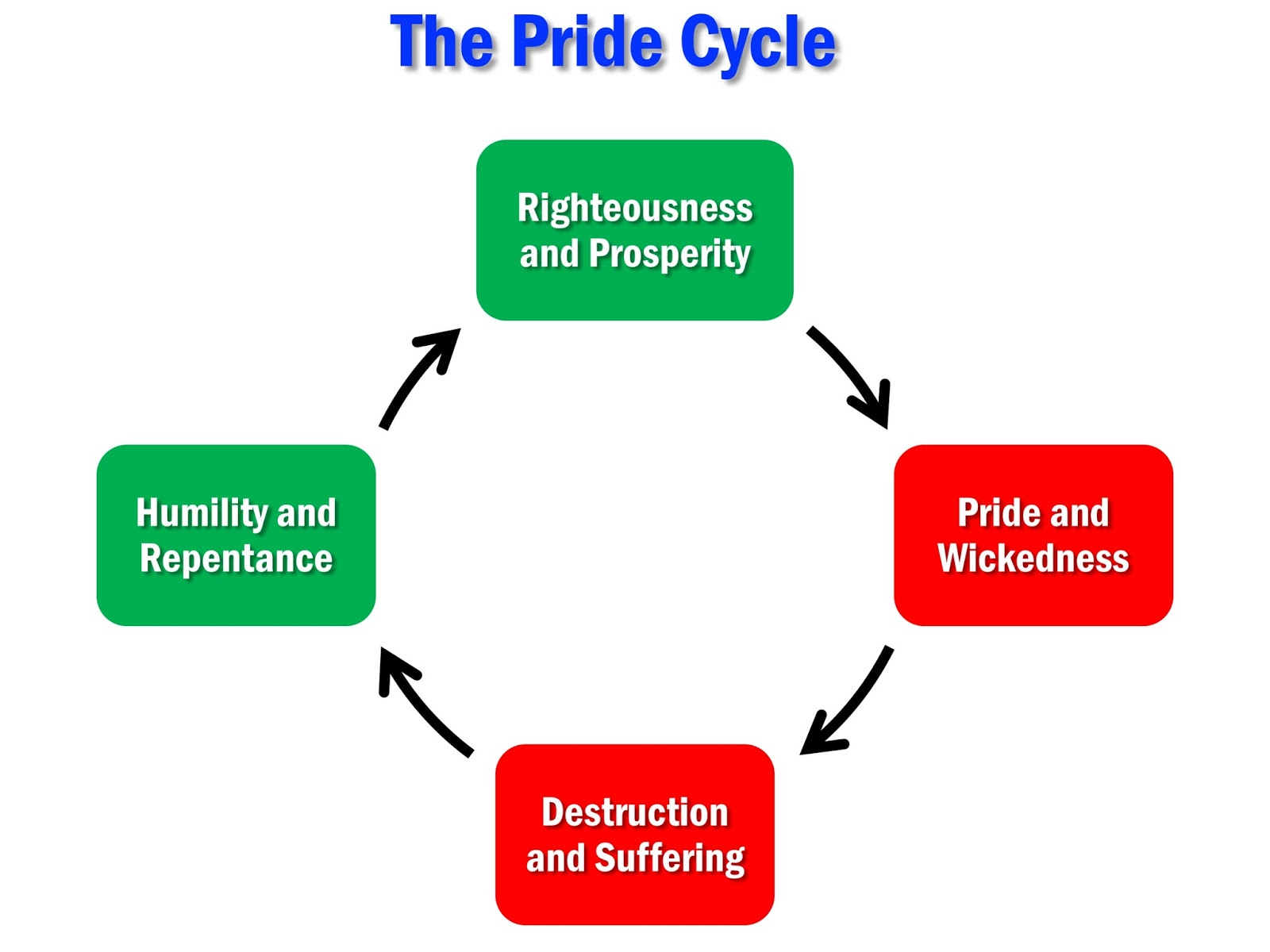
The Pride Cycle
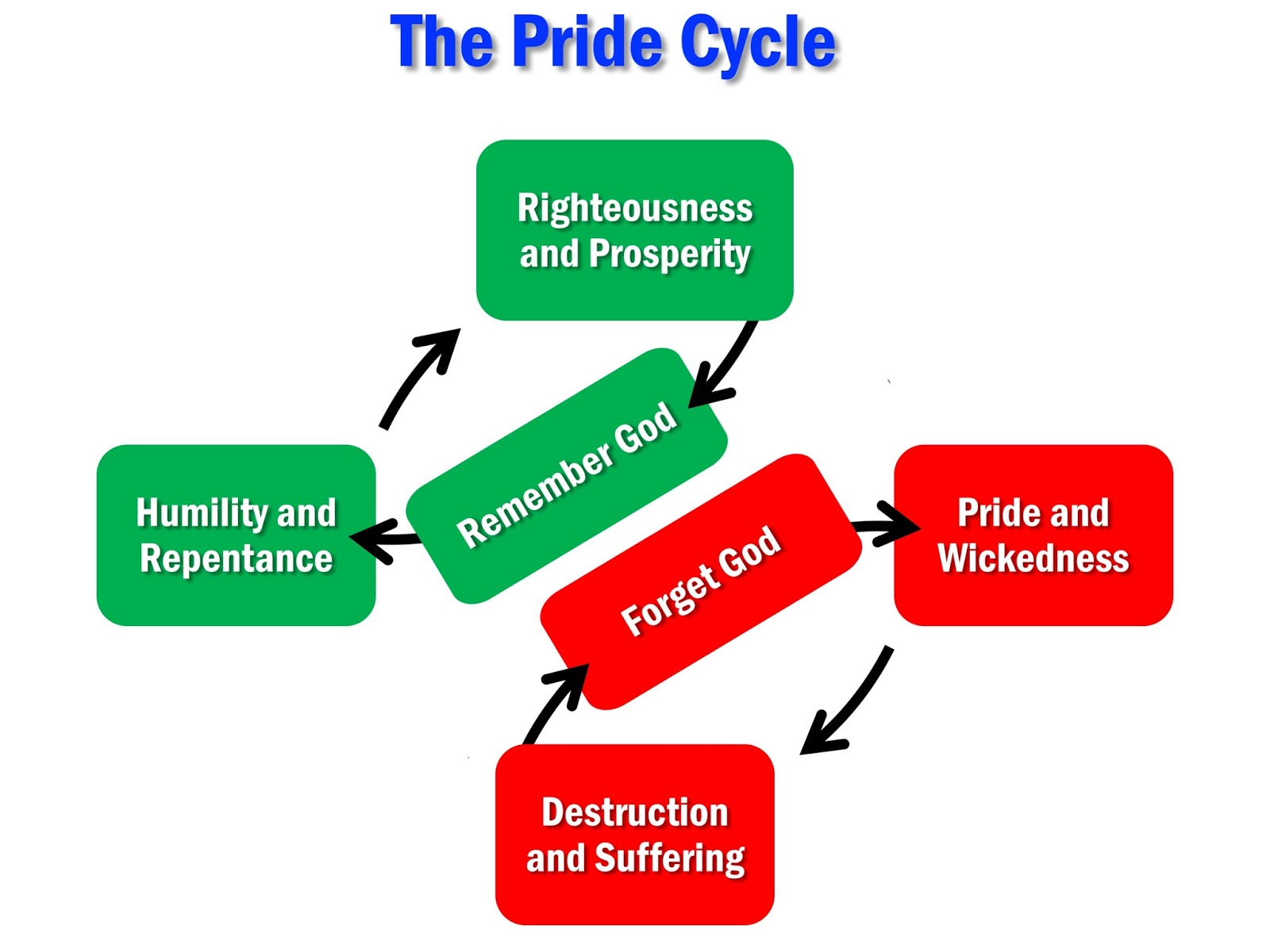
The Book of Mormon shows over and over how the pride cycle led to the destruction of people and even entire civilizations.  But I can experience that cycle within myself.  The cycle shows how righteous and prosperity can lead to pride and wickedness.  


How do I break that cycle?  If I can remember God and stay humble and repentant, then I can avoid pride and wickedness.  


But how do I remember God?  Here are a few ideas.


The Primary answers of praying and studying the scriptures are great ways to focus on God.  Reading about the Lord in the scriptures helps me to know Him better.  Praying helps me to draw nearer to him.  Both help us to “put on the whole armor” on a daily basis.


Practice gratitude—recognize God’s hand in my life.  For a perfectionist, gratitude doesn’t come easily.  It’s hard to be grateful when I feel flawed, inadequate, broken, and “not enough.”  But just as I can practice other positive habits, I can practice gratitude.  Each day, as part of my morning “mindfulness,” I write down three new things for which I’m thankful.


Serving others also helps me to better know Him.  “For how knoweth a man the master whom he has not served?” (Mosiah 5:13).  “When ye are in the service of your fellow beings ye are only in the service of your God” (Mosiah 2:17).


It should be obvious, but if I don’t remember the Lord, then I am in danger of forgetting Him—and heading down the destructive path of the Pride Cycle  “Then beware lest thou forget the Lord” (Deut. 6:12).  How do you remind yourself to stay focused on God throughout the day?  
To be continued . . . with Part 24

Confessions of a Recovering Perfectionist – Part 22

This is going to be another post about shame.  If you wonder why I keep harping on this subject, I just want you to know that understanding shame and what it does to me and how to become shame resilient has been some of the most significant findings of my life.

It has now been more than two years since I started “shame therapy.”  I didn’t call it that when I started.  In fact, I didn’t claim shame for most of my life.  While growing up, I don’t remember a lot of times when people said to me, “Shame on you!” or “You ought to be ashamed of yourself!”  The shame was most often unintentional, implied, or even unspoken.  But the perceived expectations were there, nonetheless.  And they certainly took their toll.


My therapist never called it shame therapy, but we have been using Brené Brown’s shame curriculum in my sessions with him.  The curriculum includes a set of worksheet, video clips, and other assignments geared toward helping me accurately recognize shame and its effects in myself, and then giving me the skills and knowledge to become shame resilient.  Identifying shame triggers, knowing how shame manifests itself in me physiologically, and practicing how to react productively have been invaluable in my recovery.

Brené Brown teaches that shame is the birthplace of perfectionism.  Much as I resisted that reality for a long time, it’s true.  Anyone who is experiencing perfectionistic tendencies, low self-worth, faulty core beliefs, or chronic feelings of inadequacy is dealing with shame, whether we acknowledge it or not.  


From time to time I’ve wondered how this shame work aligns with the gospel.  When I give Brené Brown such credit for helping me, instead of giving that glory to the Lord, am I trusting in “the arm of flesh” instead of “relying alone on the merits of Christ”?  (Moroni 6:4.)  Am I promoting “the philosophies of men” more than the teachings of Christ?  

It may seem that way.  But I’m increasingly becoming aware of the hand of God in other mortal servants.  Pres. Kimball said that “God does notice us, and he watches over us. But it is usually through another person that he meets our needs.”  (Ensign, Dec. 1974.)  Pres. Benson said that if we turn to God, He will “raise up friends” to help us.  (Ensign, Dec. 1988.)  I would definitely include Brené and also my therapist in that group of friends, along with others in my “support” network.  

I also believe, as Saint Brené says, “The more we talk about shame, the less we have it.  And the less we talk about shame, the more we have it.”  So this blog is part of my recovery.  There is much research establishing the therapeutic benefits of journaling.  As much as it is uncomfortable for me to be this vulnerable, the growth I receive is definitely worth the discomfort.  
To be continued . . . with Part 23.

Confessions of a Recovering Perfectionist – Part 21

I serve on the high council in my stake.  So most months I speak in one of the twelve wards in Sacrament Meeting.  This year my main topic has been the idea of focusing outward instead of inward.  

The primary concept is from a talk Elder Bednar gave at BYU-Idaho called “The Character of Christ.”  He taught that “Throughout His mortal ministry . . . the Savior of the world turned outward—when the natural man or woman in any of us would have been self-centered and focused inward.”  My initial thought when I heard the talk was that if I want to be like Christ, I must focus on others instead of myself.  Shouldn’t that be my quest?  If I could lose myself in the service of others, then I’d be very Christlike.
One of the problems with this kind of thinking is that it’s very black-or-white.  Can I really spend all of my time focusing on others, and not myself?  Is it possible or good to always focus outward?  Are there times when we could appropriately focus inward?  I believe there are.  
If you’ve flown on on airplane you’ll remember one of the instructions you were given:  “In the event of a loss of cabin pressure, oxygen masks will drop from the overhead area. Please place the mask over your own mouth and nose before assisting others.”
This is an interesting principle.  In the event of an emergency, if I’m going to be able to help the child beside me secure his oxygen mask, I need to first secure my own.  If I am going to be able to help my neighbours, I first need to put on my own oxygen mask.  What might appear to be a self-serving act is actually the condition for being able to care for others.
You’ve probably also heard concepts like these:
You can’t pour from an empty cup.  Take care of yourself first.  You cannot serve from an empty vessel.  When you take time to replenish your spirit, it allows you to serve others from the overflow.  

Self-compassion should be an important aspect of the compassion we show.

Another way to look at self-care is “recharging your battery” so that you can operate optimally.
Stephen R. Covey refers “sharpening the saw.”  You can’t cut down a tree very well if your saw is dull.

I believe that there are times when I can appropriately focus inward.  
Let’s look at a few examples from the scriptures:
Before he began his ministry, the Savior spend time in the wilderness fasting for 40 days.  This was an important part of his preparation to go forth.  (Matt 4:1-2.)
Christ told Peter that he should first concentrate on his own conversion, and then he should strengthen his brethren.  (Luke 22:32.)
Enos went to hunt beasts in the forest, his soul hungered, and he cried unto God in mighty prayer.  His sins were forgiven him because of his faith in Christ.  Once he had received his own conversion, he then prayed for the welfare of his brethren—both the Nephites and the Lamanites.  He moved from an inward focus to an outward focus.  (Enos 1:1-11.)
Because we live in a fallen world, it’s not possible to always have an outward focus.  But my focus is an indication of my level of conversion.  As I become more like Christ, and develop a character more like His, my tendency will be to focus less on myself and more on others.  As I receive the mighty change of heart, my concerns will be more outward than inward.  

To be continued . . . with Part 22.

Confessions of a Recovering Perfectionist – Part 20

Twice each year as I watch General Conference, I specifically listen for teachings that support me in my efforts to deal effectively with my perfectionistic tendencies.  
The quintessential talk this time was Am I Good Enough? Will I Make It? by Elder J. Devn Cornish of the Seventy, in the Saturday Morning Session.  Here are the parts that stood out to me.
Our members often ask, “Am I good enough as a person?” or “Will I really make it to the celestial kingdom?” Of course, there is no such thing as “being good enough.” None of us could ever “earn” or “deserve” our salvation, but it is normal to wonder if we are acceptable before the Lord, which is how I understand these questions.
Sometimes when we attend church, we become discouraged even by sincere invitations to improve ourselves. We think silently, “I can’t do all these things” or “I will never be as good as all these people.”
Let me be direct and clear. The answers to the questions “Am I good enough?” and “Will I make it?” are “Yes! You are going to be good enough” and “Yes, you are going to make it as long as you keep repenting and do not rationalize or rebel.” The God of heaven is not a heartless referee looking for any excuse to throw us out of the game. He is our perfectly loving Father, who yearns more than anything else to have all of His children come back home and live with Him as families forever. He truly gave His Only Begotten Son that we might not perish but have everlasting life! Please believe, and please take hope and comfort from, this eternal truth. Our Heavenly Father intends for us to make it! That is His work and His glory.
I sometimes think we don’t recognize how very much the Lord wants to help us. I love the words of Elder David A. Bednar, who said:
“Most of us clearly understand that the Atonement is for sinners. I am not so sure, however, that we know and understand that the Atonement is also for saints. The Atonement provides help for us to overcome and avoid bad and to do and become good. It is through the grace of the Lord that individuals receive strength and assistance to do good works that they otherwise would not be able to do. This grace is an enabling power or heavenly help each of us desperately needs to qualify for the celestial kingdom.”
All we have to do to receive this heavenly help is to ask for it and then to act on the righteous promptings we receive.
As an intensive care pediatrician, I know that if one inappropriately rejects lifesaving treatment, it can lead needlessly to physical death. Similarly, when we rebel against God, we reject our only help and hope, who is Jesus Christ, which leads to spiritual death. None of us can do this on our own power. None of us will ever be “good enough,” save through the merits and mercy of Jesus Christ, but because God respects our agency, we also cannot be saved without our trying. That is how the balance between grace and works works. We can have hope in Christ because He wants to help and change us. In fact, He is already helping you. Just pause and reflect and recognize His help in your life.
I witness to you that if you will really try and will not rationalize or rebel—repenting often and pleading for the grace, or help, of Christ—you positively are going to be “good enough,” that is, acceptable before the Lord; you are going to make it to the celestial kingdom, being perfect in Christ; and you are going to receive the blessings and glory and joy that God desires for each of His precious children—including specifically you and me.
These teachings are “perfect” for those of us trying to be perfect.  They give me hope that I can make it.  The more I hear these kinds of affirming truths, the better able I am to combat the “gremlins” that whisper to me faulty ideas that damage my self-worth.  As Elder Cornish spoke, I felt the Lord’s love for me, and His Spirit whispered to me that “it’s true.”  This is why I love Conference so much!
To be continued . . . with Part 21.

Confessions of a Recovering Perfectionist – Part 19

Doing Things for the Right Reasons
The perfectionist approach to doing things is very much a checklist mentality: I’ve gotta keep all the rules and commandments so I can feel good about myself and receive the blessings.’  If I pay tithing, the Lord will pour out blessings upon me (Malachi 3:10).  When I receive any blessing from God, it is because of obedience to a law, right (D&C 130:20)?  So does it matter why I obey?  If I’m just checking things off my list, will I still be as blessed as I would if I had proper motives?  It’s a good question.


It extends to how I treat others.  The Gospel is all about loving and caring and giving and serving my fellowmen.  And supposedly I’ll be blessed for doing so.  But does my motivation for serving others matter?  Moroni tells me that if I give a gift grudgingly, it’s as if I hadn’t given it and it is counted as evil (Moroni 7:8).  Paul teaches that if I don’t have charity, then I could give away all my goods to feed the poor, and it would profit me nothing (1 Corinthians 13:3).   


So it’s not enough just to do good; I have to do it for the right reasons.  If my heart isn’t in the right place, I won’t receive the blessing.  


But here in this fallen world, my heart isn’t always in the right place.  I don’t always want to do the right things.  
Focusing Outward or Inward?
This summer I read a book called “The Outward Mindset.”  It’s by the Arbinger Institute, the same group that created “Leadership and Self-Deception” and “The Anatomy of Peace.”  The main premise of the book is that we can improve our relationships with others as we change our mindset to see others not as objects, but as real people.  Rather than focusing on changing my behavior with others, if I change my mindset towards them, then my behaviors will also change in congruent ways.  


This aligns with what Elder Dale G. Renlund taught in his first General Conference talk:  

To effectively serve others we must see them through Heavenly Father’s eyes. Only then can we begin to comprehend the true worth of a soul. Only then can we sense the love that Heavenly Father has for all of His children. Only then can we sense the Savior’s caring concern for them. We cannot completely fulfill our covenant obligation to mourn with those who mourn and comfort those who stand in need of comfort unless we see them through God’s eyes. This expanded perspective will open our hearts to the disappointments, fears, and heartaches of others. We need to have eyes that see, ears that hear, and hearts that know and feel. Only when we see through Heavenly Father’s eyes can we be filled with “the pure love of Christ.”


When I truly see others through Heaven’s eyes, I will serve them for the right reasons.  


In 2003 Elder David A. Bednar gave a talk at BYU-Idaho called “The Character of Christ.”  He said that Christ’s character is that He “turned outward, when the natural man or woman in any of us would have been self-centered and focused inward.”  So the more I become like Christ and take His character upon me, the more I will focus on others.  The more I develop a heart like His, the more love and concern I will show for others, and the less self-absorbed I will be.  


The Arbinger Institute is right, when I have an outward mindset, my relationships with others will improve and I will serve them with a sense of genuineness, rather than out of duty.  My desires will be pure.  My heart will be in it.

To be continued . . . with Part 20.