
Confessions of a Recovering Perfectionist – Part 124

I’ve noticed something lately about perfectionism—sometimes it helps me, but other times it feels like it’s taking me down unproductive roads. Turns out, psychologists actually break perfectionism into two types: adaptive and maladaptive. Knowing the difference has helped me make peace with my own tendencies, and I want to share a bit of what I’ve been learning.

Adaptive perfectionism is the kind of perfectionism that pushes us to do our best. It’s about high personal standards, striving for excellence, and wanting to grow. I think of this as the healthy type. It’s what makes an artist keep refining their craft or a student commit to continuing learning. It’s about goals, effort, and improvement. And when it’s balanced, it can feel good. There’s satisfaction in finishing something and knowing you gave it your best shot, not to prove something to the world, but because it matters to you.

Maladaptive perfectionism is a totally different experience. This is the side that shows up as harsh self-criticism, constant fear of failure, and feeling like nothing you do is ever enough. I’ve been there: you finish something and instead of feeling proud, you’re focused on the one tiny mistake or thinking about how someone else could’ve done it better. It’s exhausting, and honestly, it steals a lot of joy from life.

A study funded by the NIH (National Institutes of Health) confirmed what many of us already sense intuitively: maladaptive perfectionism is directly tied to anxiety, depression, and even burnout. What really hit me is that this kind of perfectionism isn’t about healthy ambition—it’s about fear. Fear of disappointing others, fear of being exposed as not good enough, fear of failure itself.

So, how do we work with this?

For me, the shift started when I realized I don’t have to get rid of all perfectionism—I just need to work on making sure it’s the adaptive kind, not the toxic kind. Here are a few things that have been helping:

Self-compassion over self-criticism. It sounds cliché, but it works. Instead of tearing myself down for what’s not perfect, I try to speak to myself the way I’d talk to a good friend.

Setting flexible standards. I still value quality, but I’ve stopped demanding flawlessness. Sometimes 80% is more than enough to get the job done.

Redefining success. I’ve started focusing more on effort, learning, and growth, not just the outcome.

Letting go of “all or nothing.” Progress is still progress, even if it’s messy or slower than I wanted.

At the end of the day, perfection isn’t the goal anymore. Growth is. Excellence is good, but perfection is an illusion.

If you struggle with perfectionism like I have, know this: you’re not alone. And you don’t have to perfect your way into being okay. You’re already okay, right here, right now—with or without the gold star.

As I’ve worked through my own perfectionistic tendencies, the gospel of Jesus Christ has brought me a kind of peace that no checklist or personal achievement ever could. The Savior never once said, “Be perfect now.” He said, “Come unto me.” That invitation isn’t just for the polished or the accomplished. It’s for the weary, the broken, and yes, even the ones stuck in self-doubt and never-ending to-do lists. I’ve come to believe that Jesus doesn’t require flawlessness; He asks for humility, faith, and a heart willing to grow.

Ether 12:27 that has become a lifeline for me: “And if men come unto me I will show unto them their weakness.” That verse used to feel like a reminder of how far I fall short. But now I see it as a reminder that weakness isn’t a disqualifier; it’s part of the path. The gospel flips perfectionism on its head. Instead of earning worth through performance, I’m learning to receive grace through relationship. It’s not about proving myself to God. It’s about trusting that I’m already loved and that His grace is sufficient as I continue the journey.

Confessions of a Recovering Perfectionist – Part 118

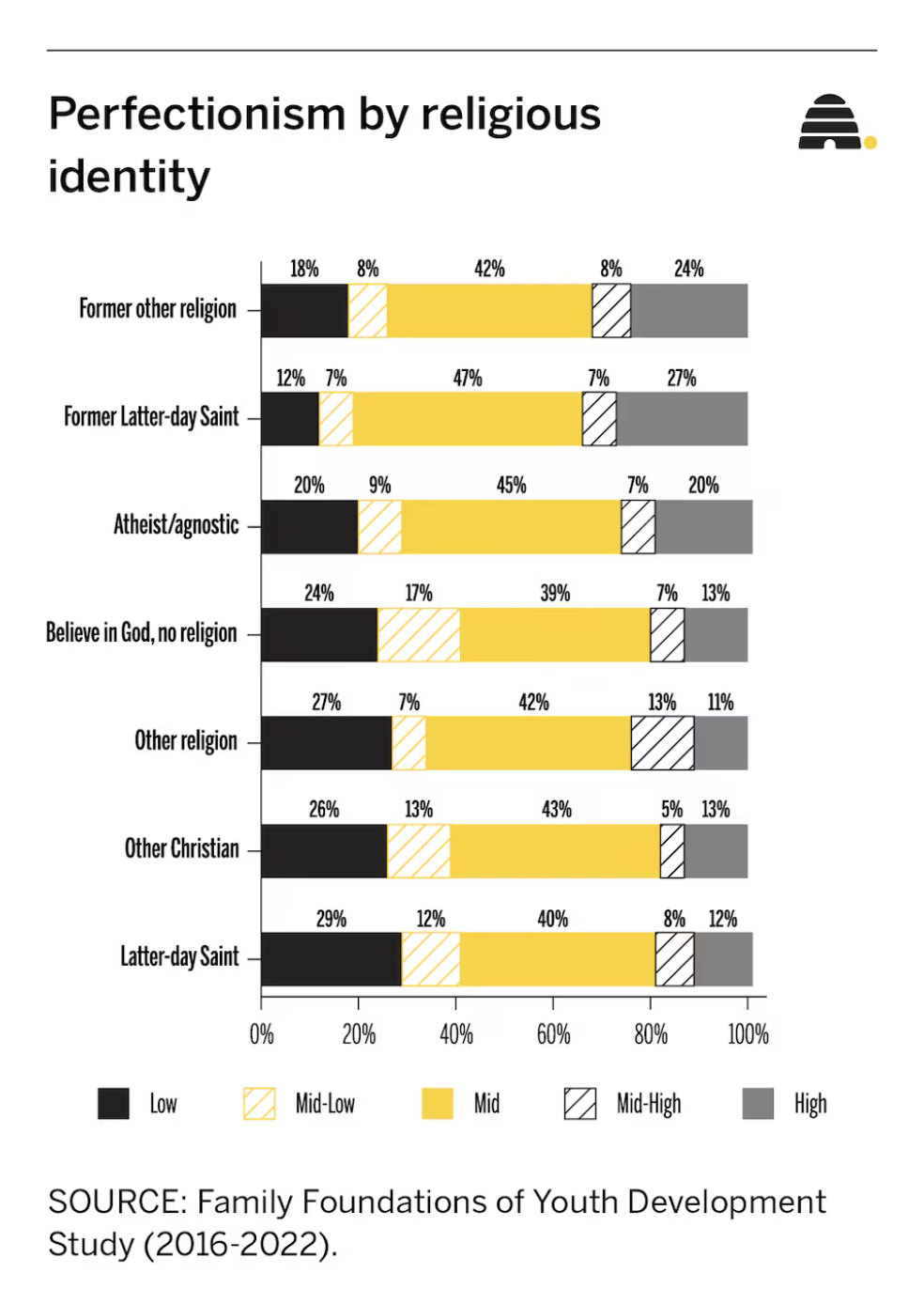
Whenever I see the topic of perfectionism show up in mainstream media, it has my attention. That’s why, when I saw an article in the Deseret News, I was particularly interested. The article Does religion lead to more or less perfectionism? discusses findings published in last month’s issue of the peer-reviewed journal BYU Studies Quarterly focusing on Latter-day Saints and perfectionism. Here are some segments I found intriguing: 

Here are five takeaways from the report:

  • Not all perfection-seeking is the same.
  • Families really do play a significant role in how their children feel about growth, mistakes, and overall worth.
  • Toxic perfectionism really can hurt mental health.
  • One form of perfectionism, in particular, calls for healing.
  • Toxic perfectionism can push people away from God and religion participation.

I’ll let you read the whole article if you are inclined. I found it fascinating since it’s referring to people like me. Much of it resonated well with me. 

Confessions of a Recovering Perfectionist – Part 114

It was 10 years ago this month that I seriously decided to meet with a counselor. 

The world in which I grew up held a stigma toward counseling. If I weren’t able to deal with whatever life dealt me, then I was weak and incapable. Only really messed-up people needed to see a shrink. 

But I finally decided that I needed help with my perfectionistic thinking. So, since then, I’ve come to be a proponent of receiving counseling. Maybe not everyone needs it, but many could benefit from help from a qualified support person. In addition to professional counselors, this could include life coaches, social workers, mentors, sponsors, and even just a trusted friend lending a listening ear. 

I had my “main” counselor for almost 8 years. We typically met for an hour per week. Fortunately, my insurance paid for most of the cost and my copay was minimal. When I retired, I needed to find a new one, since he didn’t take my retiree insurance. I’ve been through three more, to find another one who was the right fit for me. I need to feel like the counselor has the expertise to help me, there needs to be a rapport between us, and I need to feel that he/she genuinely cares about me. 

Here are some of the ways in which counseling has benefited me. 

My counselor has helped me with perfectionism in really supportive and practical ways. First, he created a safe space where I felt comfortable opening up about my struggles. Perfectionism can be exhausting, and I sometimes feel like I have to constantly be on-task or that I’m not good enough, so it’s important that a counselor listens without judgment.

He has helped me recognize the underlying beliefs driving my perfectionism. A lot of times, perfectionists feel like their worth is tied to how well they perform, or they’re afraid of failure because it feels like a personal reflection of who they are. My counselor worked with me to challenge these beliefs and start breaking down the idea that I need to be perfect to be valuable.

Another thing my counselor has done is encourage me to set more realistic goals and expectations for myself. Instead of aiming for “perfect,” he has helped me aim for “good enough” in different areas of my life. He’d talk through what those more balanced goals might look like and how to be okay with things not going perfectly all the time.

My counselor also taught me coping skills for dealing with the stress that comes up when things don’t go as planned. For example, he showed me how to practice self-compassion—talking to myself kindly rather than beating myself up for every little mistake. He also helped me learn how to step back and take breaks, rather than pushing myself to the point of burnout.

He has helped me uncover where these perfectionist tendencies started—some in childhood, some from pressure at school and work—and then we worked on healing from that. The goal wasn’t for me to stop caring about doing things well, but to help me feel more balanced, more at peace with myself, and less driven by fear and unrealistic expectations.

I’ve appreciated that my counselor has walked alongside me as I’ve learned to let go of the need for perfection and embrace being human, with all the imperfections that come with it.