
Perfectionism and the People Who Draw Us Out
There’s an old saying: “Show me a person’s friends and I’ll show you the person.”
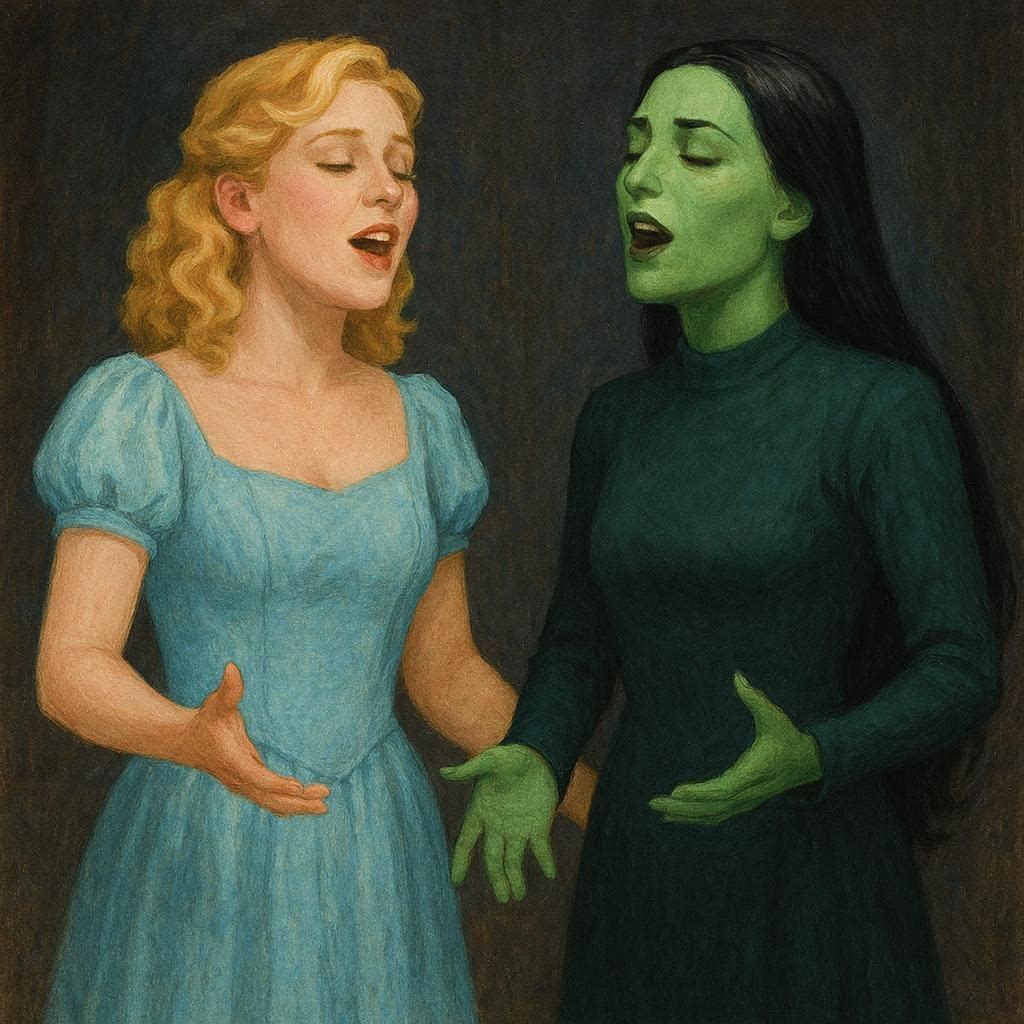
I’ve heard it said
That people come into our lives
For a reason
Bringing something we must learn
And we are led
To those who help us most to grow
If we let them
And we help them in return
Well, I don’t know if I believe that’s true
But I know I’m who I am today because I knew you
Like a comet pulled from orbit
As it passes a sun
Like a stream that meets a boulder
Halfway through the wood
Who can say if I’ve been changed for the better?
But because I knew you
I have been changed for good
— Schwartz, Stephen (2003). “For Good”
I recently came across a quote from Yohan Delton that got me thinking about the influence others have on me:
I want to share a concept that I believe is worth sitting with: personality as a co-construction. Think of your best friend; now imagine that person disappears from your life. Of course, you would grieve the loss of them, but that’s not all you would lose; you would also lose a particular version of yourself that only they could bring out. You may have stood in front of a mirror trying to summon that version and found that it doesn’t work, and that’s because this person is, in a very real sense, a partial owner of your personality; they have access to dimensions of you that you yourself cannot unlock, and that is precisely why you love them. You didn’t just love the person; you loved who you became in their presence.
This illustrates something important: personality is not a fixed, internal property of isolated individuals; it is a co-construction, something that emerges between persons, in relationship, and so too is our shared reality. This means that reality and awareness are not self-contained events generated from within; they are co-constructed with the people around us, and different people will draw out different parts of us, some of which may genuinely surprise us or frighten us. This is why surrounding ourselves with a diversity of people may be one of the most powerful paths to self-knowledge; not because they tell us who we are, but because in their presence, we discover who we are.
This is also why the Church is so vital to our growth; unlike chosen friendships, our ward communities are composed of people we did not select, and it is precisely that unchosen diversity that draws out dimensions of ourselves we never knew were there. And if personality is truly co-constructed, then there is no greater context for becoming our fullest selves than in the presence of Christ, who sees and calls forth what no one else can.
— Yohan Delton (Personal correspondence.)
One of the things that struck me about this quote is how much it clashes with perfectionism.
Perfectionism tells us that life is all about fixing ourselves. We think if we can just work hard enough, improve enough, and get rid of enough weaknesses, we’ll finally become the person we’re supposed to be. It’s a very lonely way of looking at growth. It assumes that becoming better is mostly an individual project.
But when I look back on my own life, that’s not really how growth has happened.

Different people have brought out different parts of me. Some people bring out my sense of humor. Some bring out compassion. Some bring out confidence. And, if I’m being honest, some people bring out my insecurities, my impatience, and my perfectionism. Those relationships didn’t create those parts of me, but they revealed them.
That’s one reason I think perfectionism can be so frustrating. It wants us to be consistent, polished, and in control all the time. Real life doesn’t work that way. We are constantly discovering new things about ourselves through our interactions with other people. Sometimes we discover strengths we didn’t know we had. Sometimes we discover wounds that still need healing.
I also think this helps explain why church can be such a powerful place for growth. If I got to hand-pick everyone in my ward, I’d probably choose people who think like me, vote like me, and see the world like me. But that’s not how the Lord designed it. Instead, He puts us in a community with people we would never have chosen on our own. As frustrating as that can be at times, those relationships often stretch us in ways we wouldn’t experience otherwise.
The part of Delton’s quote that I keep coming back to is his observation about Christ. If other people can bring out parts of us that we can’t access on our own, imagine what happens when we spend time with the Savior.
Perfectionism says, “Become better, then come to Christ.”
Jesus says, “Come to Me, and together we’ll work on becoming better.”
Maybe the goal of life isn’t to create a perfect version of ourselves through sheer effort. Maybe the goal is to stay connected (to Christ and to other people) and allow those relationships to draw out the person God always knew we could become.

